
Private REITs vs Non-Traded REITs vs Public REITs: How They Differ
Short answer: All three are real estate investment trusts: companies that own or finance income-producing real estate and pay out most of their taxable income to shareholders. The difference is how you buy them, how you get your money back, and how much information you get.
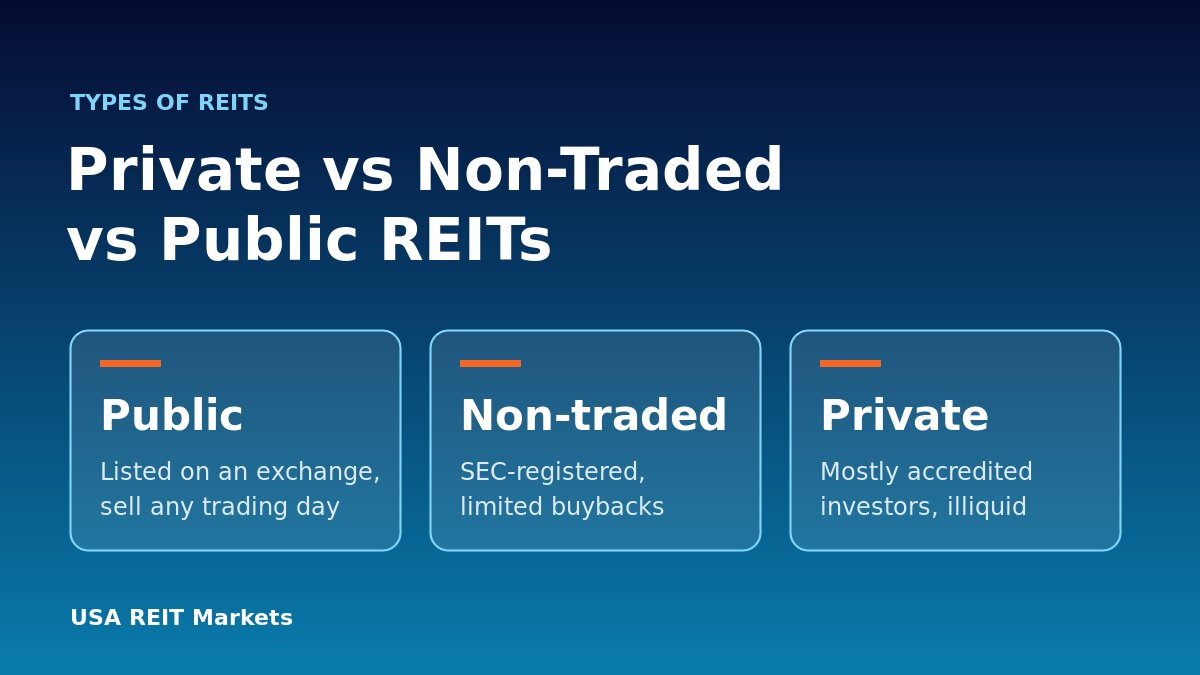
- Publicly traded REITs are registered with the SEC and listed on a stock exchange. You can buy or sell shares any trading day through a brokerage account.
- Public non-traded REITs (also called non-listed REITs) are registered with the SEC and file public reports, but they don't trade on an exchange. You buy through a broker-dealer or adviser, and getting out depends on the REIT's limited share repurchase program.
- Private REITs aren't registered with the SEC or listed. They're sold in private offerings, usually only to accredited or institutional investors, with fewer disclosure requirements and often no way to sell until the REIT winds down.
What makes a company a REIT?
Every REIT, whatever kind, has to meet the same federal tax rules to avoid paying corporate income tax. The main ones:
- Mostly real estate: at least 75% of its assets in real estate, cash or government securities, and at least 75% of its gross income from real estate, such as rents and mortgage interest.
- Pay out income: distribute at least 90% of its taxable income to shareholders each year. Many pay out close to 100%.
- Widely held: at least 100 shareholders (from its second year), and five or fewer individuals can't own more than half of it.
In exchange, the REIT generally pays no corporate tax on the income it distributes. The tax is paid by shareholders instead. That's why REITs are known for income: the structure pushes most of the cash out to investors. For the basics, see what a REIT is and how it works.
The three kinds below can own the same types of property. What differs is the wrapper.
Publicly traded REITs
Publicly traded REITs are listed on exchanges like the NYSE and Nasdaq, so you can buy them like any stock or through REIT mutual funds and ETFs.
- Liquidity: high. You can sell any trading day at the market price.
- Price: set by the market every second. That means more day-to-day ups and downs, and the share price can move away from the value of the properties.
- Information: quarterly and annual reports filed with the SEC, plus analyst coverage.
- Costs: a brokerage commission, if any, and the REIT's own operating costs.
- Who can invest: anyone, for the price of one share.
Public non-traded REITs
Non-traded REITs register their offerings with the SEC and file the same kinds of reports as listed companies, but their shares aren't traded on an exchange. They're sold through broker-dealers and financial advisers, and many states set minimum income or net worth standards for buyers.
There are two main types.
NAV REITs (also called perpetual-life REITs) keep raising money with no set end date. They calculate a net asset value (NAV) per share, usually monthly, and sell and buy back shares at that price. Their repurchase programs commonly limit buybacks to about 2% of NAV a month and 5% a quarter, and the board can limit or suspend them. When many investors ask for their money at once, requests get filled partly or not at all. That happened at several large NAV REITs in 2022 and 2023.
Traditional (lifecycle) non-traded REITs raise money for a fixed period, invest it, and aim for a "liquidity event" years later: listing on an exchange, a merger or a sale of the portfolio. Until then, redemption programs are typically small and restricted. The SEC notes that a liquidity event might not happen for more than 10 years.
What the SEC and FINRA tell investors to watch:
- Up-front costs: commissions and offering costs have often run around 10% of the amount invested, and the SEC has cited ranges up to 15%, plus ongoing management and other fees. Newer share classes often have lower up-front charges and an ongoing fee instead. Read the fee table in the prospectus.
- Distributions vs returns: some non-traded REITs have paid distributions larger than their operating cash flow, funding the difference with borrowing or new investors' money. That can make the yield look better than the underlying business. Look at total return, not just the distribution rate.
- Valuation: there's no market price. FINRA requires brokerage statements to show a per-share estimated value and to disclose that the shares are illiquid and may sell for less.
- Selling early: besides the repurchase program, some third parties make tender offers for non-traded REIT shares, often well below the stated value. Compare any offer with the REIT's latest NAV before you accept.
Reg A+ REITs
Some non-traded REITs raise money under Regulation A+, a lighter SEC exemption that lets companies sell to the general public, not just accredited investors, with offering circulars instead of a full registration. Non-accredited investors in the larger Tier 2 offerings are generally limited to investing 10% of the greater of their annual income or net worth in a single offering. Liquidity is usually limited in the same way as other non-traded REITs. Learn more about Reg A offerings.
Private REITs
Private REITs meet the same tax rules as other REITs but skip SEC registration. They raise money in private placements, most often under Regulation D, which generally limits them to accredited investors (for individuals, roughly $200,000 of income, $300,000 with a spouse, or $1 million of net worth excluding your home) and institutions.
- Information: they file a short notice (Form D) with the SEC but aren't required to publish quarterly or annual reports. What you get depends on the offering documents and the sponsor.
- Liquidity: often none, or a limited redemption feature set by the sponsor, until the REIT sells its properties or the fund ends.
- Minimums: usually much higher than public REITs, often tens of thousands of dollars or more.
- Fees: set by each sponsor. Management fees, acquisition fees and a share of profits are common.
- Why investors use them: access to specific strategies or sponsors, and prices that don't move with the stock market every day. The trade-off is less transparency and money that's tied up.
Many private REITs are used by institutions and sponsors as a tax-efficient structure for real estate funds. For individual investors, the questions are the same as with any private real estate investment: who the sponsor is, what the fees are, and when you can get out. See our guide to private real estate investing.
Private vs non-traded vs public REITs at a glance
| Publicly traded REIT | Public non-traded REIT | Private REIT | |
|---|---|---|---|
| SEC registered | Yes | Yes | No (Form D notice only) |
| Listed on an exchange | Yes | No | No |
| Who can invest | Anyone | Anyone meeting state suitability standards | Usually accredited and institutional investors |
| Typical minimum | One share | A few thousand dollars | Often tens of thousands of dollars or more |
| Getting your money out | Sell any trading day | Limited repurchase program (NAV REITs often 2% a month, 5% a quarter) or a future liquidity event | Often none until the REIT winds down |
| Pricing | Market price, daily | NAV, often monthly, or an estimated value | Set by the sponsor, often infrequently |
| Public reporting | Quarterly and annual SEC reports | Quarterly and annual SEC reports | Not required |
| Fees | Lowest | Up-front and ongoing fees can be significant | Varies by sponsor |
| Same REIT tax rules | Yes | Yes | Yes |
How REIT dividends are taxed
The tax treatment is the same for all three kinds:
- Ordinary dividends: most REIT dividends are taxed as ordinary income, not at the lower qualified-dividend rate.
- The 20% deduction: individuals can generally deduct 20% of qualified REIT dividends under Section 199A, which lowers the effective top federal rate on them to 29.6%. The deduction was made permanent in July 2025.
- Capital gain distributions are taxed at capital gains rates.
- Return of capital: part of a distribution may be a return of your own money. It isn't taxed when you receive it, but it lowers your cost basis, so you pay more tax when you sell.
Holding REITs in an IRA or other retirement account defers these taxes. Ask your tax adviser how this fits your situation.
Which kind fits which investor?
- You want to be able to sell any day: publicly traded REITs, accepting stock-market volatility.
- You want real estate income with less day-to-day price movement and can leave the money for years: a non-traded or private REIT may fit, if you understand the fees and the limits on getting out.
- You're an accredited investor looking for a specific strategy or sponsor: private REITs and other private offerings, such as real estate syndications and commercial real estate funds.
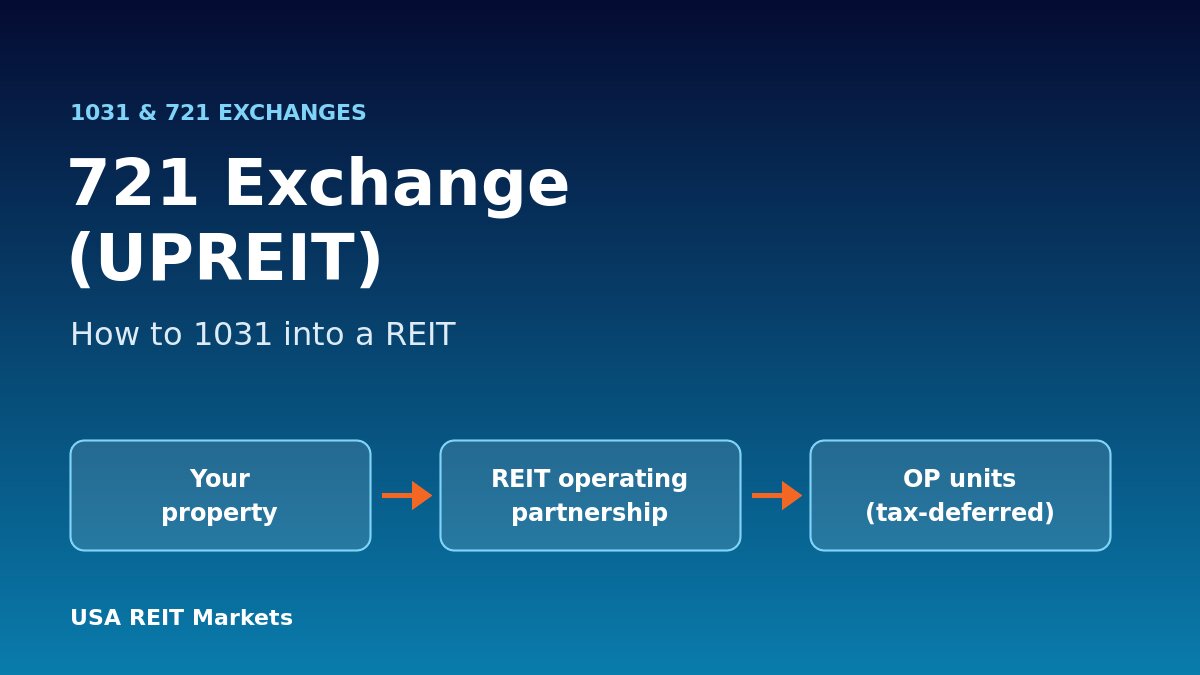
- You're selling investment property and want to defer tax: REIT shares don't qualify for a 1031 exchange directly, but a 721 exchange (UPREIT) or a Delaware statutory trust may.
For more on why investors hold REITs, see the benefits of investing in REITs for passive income.
Questions to ask before investing in a non-traded or private REIT
- What are all the fees: up-front, ongoing and on exit?
- How and when can I get my money out, and can the repurchase program be limited or suspended?
- Are distributions covered by operating cash flow, or partly by borrowing or new capital?
- How is the share value calculated, how often, and by whom?
- Who is the sponsor, and how have its past programs worked out for investors?
- What does the REIT own, and how much debt does it use?
- What reports will I receive, and how often?
FAQ
What is a private REIT?
A REIT that isn't registered with the SEC or listed on an exchange. It's sold in private offerings, usually to accredited and institutional investors, and isn't required to file public reports. It still has to meet the federal REIT tax rules.
What is a non-traded REIT?
A REIT that's registered with the SEC and files public reports but doesn't trade on a stock exchange. You buy through a broker-dealer or adviser and can usually only sell back to the REIT through a limited repurchase program, or wait for a listing, merger or sale.
What's the difference between a private REIT and a public REIT?
A public REIT is registered with the SEC; a private REIT isn't. Publicly traded REITs can be bought and sold daily by anyone, while private REITs are usually limited to accredited investors, publish less information, and are hard to sell before the REIT winds down.
What is a NAV REIT?
A non-traded REIT that keeps selling shares with no fixed end date and calculates a net asset value per share, usually monthly. Investors buy and redeem at that NAV, subject to limits that are commonly 2% of NAV a month and 5% a quarter.
Can I sell a non-traded REIT before it lists or liquidates?
Usually only through the REIT's share repurchase program, which has limits and can be suspended, or to a third-party buyer, often at a discount. Plan to hold for the long term.
Are private REITs only for accredited investors?
Most are, because they're offered under Regulation D. Some non-traded REITs that raise money under Regulation A+ are open to non-accredited investors, with limits on how much each person can invest.
How are REIT dividends taxed?
Mostly as ordinary income, with a 20% deduction for qualified REIT dividends under Section 199A. Some distributions may be capital gains or a return of capital, which lowers your cost basis.
REITs are only one route. For a side-by-side look at all the ways to invest, including funds, syndications, DSTs and owning property directly, see how to invest in commercial real estate.
Next steps
Compare current private real estate offerings on the USA REIT marketplace, learn about Reg A offerings and commercial real estate funds, or contact our team with questions.
This article is for general information only and is not investment, tax or legal advice, or an offer to sell any security. Non-traded and private REITs are illiquid, may have high fees, may not be able to repurchase your shares, and can lose value. Private offerings are generally available only to accredited investors. Read the offering documents and speak with a financial adviser and a tax adviser before investing.
Latest Articles