
Private Real Estate

What it is, how it works, and where it may fit in a modern portfolio
Most investors first meet real estate in two places: the home they live in, and the public REIT in their brokerage account.
Both matter.
But they are only part of the picture.
Behind them sits a much larger market of apartment communities, warehouses, medical offices, data centers and land that is owned privately, outside the stock exchange. That is private real estate, and for decades it was largely reserved for institutions, family offices and high-net-worth investors.
That's changing.
Before investors take part, it helps to understand how the asset class works: the opportunity and the trade-offs.
What Is Private Real Estate?
Real estate can be accessed in three broad ways: owning property directly, buying shares of publicly listed REITs, or investing in private, unlisted vehicles such as funds, private REITs and syndications.
Private real estate is property bought and held outside the public markets. As BlackRock explains in its Inside Alternatives series, institutional owners typically fund acquisitions with a mix of equity and property-level debt, much like a homeowner with a mortgage. That debt is often non-recourse, secured only by the property itself, and each asset is usually held in its own single-purpose legal entity.
The vehicles differ too. Closed-end funds raise commitments, invest them over a set number of years and then return capital. Open-ended funds accept subscriptions and redemptions over time, typically at net asset value and often with limits, sometimes called gates, that reflect how illiquid the underlying buildings are.
Public REITs vs. Private Real Estate
Public REITs trade every day. Their prices move with the stock market, sometimes more than with the buildings they own.
Private real estate is valued periodically, through appraisals rather than ticker prices. That can mean smoother reported values, but also slower ones, because appraisals can lag changes in the market.
Liquidity is the core trade-off. A public REIT can usually be sold in seconds. A private investment may need to be held for years.
Four Strategies, One Spectrum
BlackRock groups private real estate into four main strategies along a risk/return spectrum:
- Core: high-quality, fully leased, multi-tenant properties in established metropolitan markets, typically held for the long term and often in open-ended funds.
- Core-plus: largely core properties that may need renovation, repositioning or re-leasing, with moderate risk and modest leverage.
- Value-add: properties with physical or operational problems bought with a plan to improve and sell them, often over a three-to-ten-year hold and with higher leverage.
- Opportunistic: major redevelopment, new construction, raw land or niche sectors, generally in closed-end funds with high leverage.
Distressed and real estate debt strategies sit alongside these. Debt investments put more emphasis on income, and senior lenders are repaid ahead of mezzanine and equity holders.
Property type adds another layer. Multifamily, industrial and logistics, office, retail, hospitality, self-storage, healthcare and digital infrastructure such as data centers each respond differently to the economy.
Why Investors Consider It
BlackRock points to three potential benefits:
- Income. Rent from tenants, often under multi-year leases, may provide regular cash flow. Income potential is commonly gauged by the capitalization rate: net operating income divided by property value.
- Inflation sensitivity. Rents and property values have tended to rise with inflation over time, and many leases include inflation-linked increases.
- Diversification. Different strategies, property types and geographies offer a broad range of exposures within one asset class.
None of these benefits is guaranteed.
The Risks Are Real
Private real estate carries meaningful risks:
- Illiquidity: capital may be locked up for years, and redemption programs can be limited or suspended.
- Leverage: borrowing amplifies gains and losses, and rising rates can pressure refinancing.
- Market and interest rate risk: values and cash flows depend on the economy, rates and local supply and demand.
- Valuation lag: appraisal-based values may not reflect current market prices.
- Fees and complexity: management fees, sponsor promotes and offering costs reduce net returns, and structures can be complex.
- Asset-specific risk: returns depend on tenants, occupancy, management quality and maintenance.
Investors can lose some or all of their investment.
Why the Door Is Opening Now
Historically, minimums were high. Access depended on relationships. And most households were excluded: by the SEC's estimate, only about 18.5% of U.S. households met the accredited investor financial criteria in 2022.
New structures and regulations are widening the entry points:
- Non-traded REITs: publicly registered non-listed REITs raised $3.4 billion in the first half of 2026, up 20.6% year over year, according to Robert A. Stanger & Co.<sup>3</sup>
- Interval funds: interval funds held $142.0 billion in aggregate net asset value in Q3 2026, per Stanger.<sup>4</sup> On September 30, the SEC proposed changes that would modernize interval funds as part of a broader push on retail access to private markets.<sup>5</sup>
- Regulation A+: Tier 2 offerings can raise up to $75 million in 12 months from both accredited and non-accredited investors, subject to investment limits for non-accredited investors.<sup>6</sup>
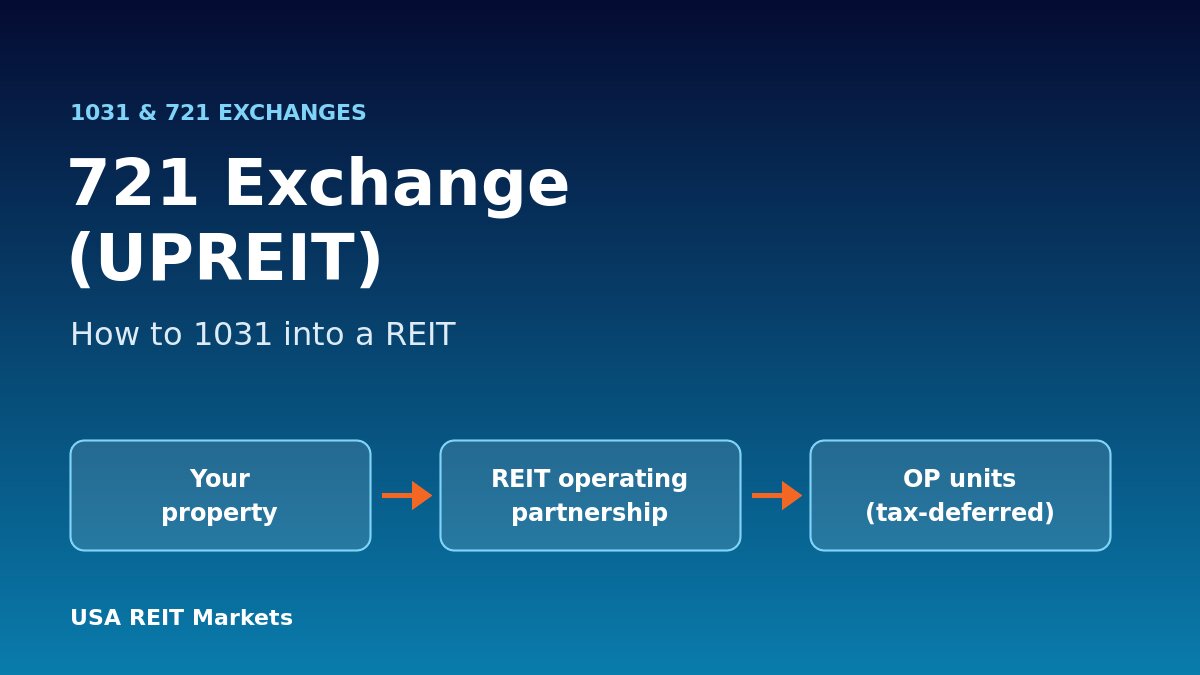
- 1031 exchanges and DSTs: Section 1031 may let qualifying investors defer capital gains tax when exchanging like-kind real property, and Delaware Statutory Trusts offer a passive way to complete an exchange. DST sales reached $7.52 billion through September 2026, up 27% year over year, according to Mountain Dell Consulting data reported by AltsWire.<sup>7</sup>
- Tokenization: digital securities may make ownership records, transfers and fractional ownership more efficient, though secondary liquidity is not guaranteed.
The asset class hasn't changed.
Access to it has.
How USA REIT Markets Fits In
At USA REIT Markets, we're building infrastructure for that next phase of access.
Powered by Capital Engine technology, our marketplace is designed to help investors discover and research private REITs, real estate funds, syndications and 1031 exchange opportunities in one place.
For sponsors, we support capital raising under Regulation D Rule 506(c) and Regulation A+, optional tokenization, and 1031/DST facilitation, with secondary trading designed to run through partnerships with regulated alternative trading systems. Certain securities-related activities are conducted through Mallory Capital Group, LLC, member FINRA/SIPC.
For investors, this means:
- Lower barriers to discovering private real estate
- Transparent information to compare opportunities
- More choice in how portfolios are built?
For sponsors, it means:
- A broader potential investor base
- Modern digital capital-raising tools
- Infrastructure built for ongoing investor relationships
Private real estate has always been one of the world's great asset classes.
The next chapter is about who gets to understand it, and who gets to participate.
Ready to explore private real estate?
Visit the USA REIT Markets marketplace or contact USA REIT Markets to learn more about our platform and educational resources.
Latest Articles