
What Is Net Operating Income (NOI) in Real Estate?
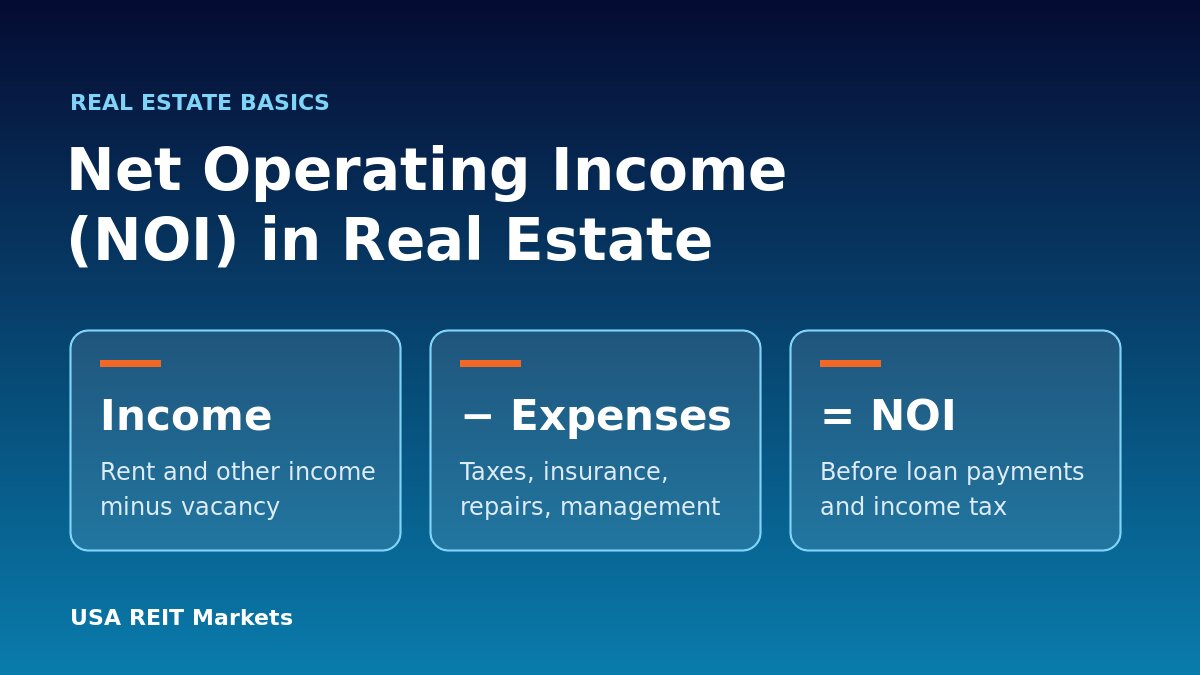
Short answer: Net operating income (NOI) is the income a property produces after paying its operating expenses, but before loan payments, depreciation and income taxes. It's the most important number in commercial real estate: investors use it to compare properties, appraisers use it to set value, and lenders use it to decide how much they'll lend.
NOI = effective gross income − operating expenses
Effective gross income is the rent and other income the property actually collects, after allowing for vacancy and unpaid rent. Operating expenses are the costs of running the property: taxes, insurance, maintenance, utilities, management and similar items.
The NOI formula, step by step
- Gross potential rent: the rent the property would collect if every unit or suite were leased at market or contract rents for the full year.
- Plus other income: parking, storage, laundry, late fees, signage, and, under many commercial leases, expense reimbursements paid by tenants.
- Minus vacancy and credit loss: an allowance for empty space and rent that isn't paid. The result is effective gross income (EGI).
- Minus operating expenses: the recurring costs of operating and maintaining the property.
- Equals net operating income (NOI).
What's included in NOI, and what's not
| Counted in NOI | Not counted in NOI |
|---|---|
| Rent collected and other property income | Mortgage principal and interest (debt service) |
| Tenant reimbursements for taxes, insurance and common area costs | Depreciation and amortization |
| Property taxes | Owner's income taxes |
| Property insurance | Capital expenditures such as a new roof, HVAC or parking lot |
| Repairs and routine maintenance | Tenant improvements and leasing commissions (usually shown below NOI) |
| Utilities the owner pays | Loan fees and costs of buying or selling the property |
| Property management fees | The owner's personal or company overhead unrelated to the property |
| Payroll for on-site staff, landscaping, cleaning, security | Interest earned on reserves |
| Administrative costs, licenses, marketing to tenants |
Replacement reserves (money set aside for future capital repairs) are handled differently by different investors and lenders. Some deduct them before NOI; others treat them as a cash-flow item below NOI. Either is acceptable, as long as you're consistent when you compare properties.
NOI example
A 40-unit apartment building:
| Line | Amount |
|---|---|
| Gross potential rent (40 units × $1,500 × 12) | $720,000 |
| Other income (parking, laundry, fees) | $24,000 |
| Less vacancy and credit loss (5%) | −$37,200 |
| Effective gross income | $706,800 |
| Property taxes | −$96,000 |
| Insurance | −$34,000 |
| Repairs and maintenance | −$52,000 |
| Utilities paid by the owner | −$38,000 |
| Property management (4% of EGI) | −$28,272 |
| Payroll, landscaping and administration | −$46,000 |
| Total operating expenses | −$294,272 |
| Net operating income (NOI) | $412,528 |
If the mortgage payments are $280,000 a year, the property's cash flow before tax is $412,528 − $280,000 = $132,528. NOI stays the same no matter how the property is financed; cash flow doesn't.
You can run your own numbers in our cap rate calculator, which works out NOI, cap rate and cash-on-cash return.
Why NOI matters
NOI and the cap rate
The capitalization rate is NOI divided by the property's price:
Cap rate = NOI ÷ price
If the building above sells for $6,500,000, its cap rate is $412,528 ÷ $6,500,000 = 6.35%.
NOI and property value
The same formula, turned around, is how income properties are valued:
Value = NOI ÷ market cap rate
If similar buildings sell at a 6% cap rate, the property is worth about $412,528 ÷ 0.06 = $6,875,000. That's why NOI matters so much: at a 6% cap rate, every extra $1 of annual NOI adds about $16.67 of value. Raising NOI by $30,000 a year, through higher rents or lower expenses, would add roughly $500,000 to the property's value.
NOI and the loan
Lenders size commercial loans largely on NOI, using the debt service coverage ratio (DSCR):
DSCR = NOI ÷ annual debt service
With $412,528 of NOI and $280,000 of loan payments, the DSCR is 1.47. Lenders usually require a minimum DSCR, often around 1.2 to 1.35, so a higher NOI supports a bigger loan.
NOI vs cash flow vs EBITDA
- NOI measures the property itself: income minus operating expenses, before financing and taxes.
- Cash flow before tax is NOI minus loan payments (and usually capital expenditures and reserves). It's what's left for the owner.
- EBITDA is a company-level measure (earnings before interest, taxes, depreciation and amortization). For a single property it's close to NOI, but EBITDA usually includes company overhead that NOI leaves out.
- Gross income is income before any expenses, and gross rent multiplier compares price with gross income. They ignore expenses, so they're less reliable than NOI.
Publicly traded REITs report NOI for their properties, but investors usually value REIT shares using funds from operations (FFO), which is company-wide earnings with depreciation added back. See our comparison of private, non-traded and public REITs.
Actual NOI vs pro forma NOI
- Trailing 12-month (T-12) NOI is based on the property's actual income and expenses over the past year.
- Pro forma NOI is a projection, often of what the property could earn after a business plan such as renovations or lease-up.
Both are useful, but they answer different questions. When you review a deal, check the T-12 against the pro forma line by line, and ask what has to go right for the projected NOI to happen. Many problems in real estate investments start with an optimistic pro forma.
How to increase NOI
- Raise rents to market levels as leases renew, or add value through renovations that justify higher rents.
- Reduce vacancy with better leasing, marketing and tenant retention.
- Add other income: parking, storage, laundry, fees or utility reimbursement programs.
- Cut operating costs: appeal property tax assessments, rebid insurance and service contracts, and invest in energy-efficient upgrades.
- Use lease structures that pass costs to tenants, such as triple-net (NNN) leases, where tenants pay their share of taxes, insurance and common area maintenance.
Red flags when reviewing a property's NOI
- No management fee, even though the owner manages the property: a buyer will have to pay one.
- Very low expenses compared with similar properties, often from deferred maintenance or missing items.
- Taxes based on the old assessment: many places reassess property taxes after a sale, which can raise them sharply.
- One-time income counted as recurring, such as a lease termination fee or insurance payout.
- Capital expenditures or reserves left out of an analysis that compares with properties that include them.
- Pro forma rents presented as if they were already being collected.
FAQ
What is NOI in real estate?
Net operating income: the income a property earns after operating expenses, but before loan payments, depreciation and income taxes.
How do you calculate net operating income?
Start with gross potential rent, add other income, subtract vacancy and credit loss to get effective gross income, then subtract operating expenses. What's left is NOI.
Does NOI include the mortgage?
No. Loan payments are excluded so that properties can be compared regardless of how they're financed. Subtract loan payments from NOI to get cash flow.
Are property taxes included in NOI?
Yes. Property taxes are an operating expense and are subtracted to calculate NOI. The owner's income taxes are not.
Is depreciation included in NOI?
No. Depreciation is a non-cash tax deduction and is excluded from NOI.
Are capital expenditures included in NOI?
Generally no. Major capital projects such as a new roof are excluded, although some investors and lenders deduct a yearly replacement reserve.
What is a good NOI?
There's no single good NOI. It depends on the property's size and price. What matters is how NOI compares with the price (the cap rate), whether it's growing, and whether it covers the loan payments comfortably.
What is the difference between NOI and gross income?
Gross income is income before expenses. NOI is income after operating expenses.
Next steps
Work out a property's NOI, cap rate and cash-on-cash return with the cap rate calculator, read how to invest in commercial real estate and how real estate syndication works, or browse current offerings on the USA REIT marketplace and commercial real estate funds. Questions? Contact our team.
This article is for general information only and is not investment, tax or accounting advice. Practices for calculating NOI vary between investors, lenders and appraisers. Verify figures with leases and operating statements before you invest. Real estate investments carry risk, including loss of principal.
Latest Articles