
721 Exchange (UPREIT): How to 1031 Into a REIT
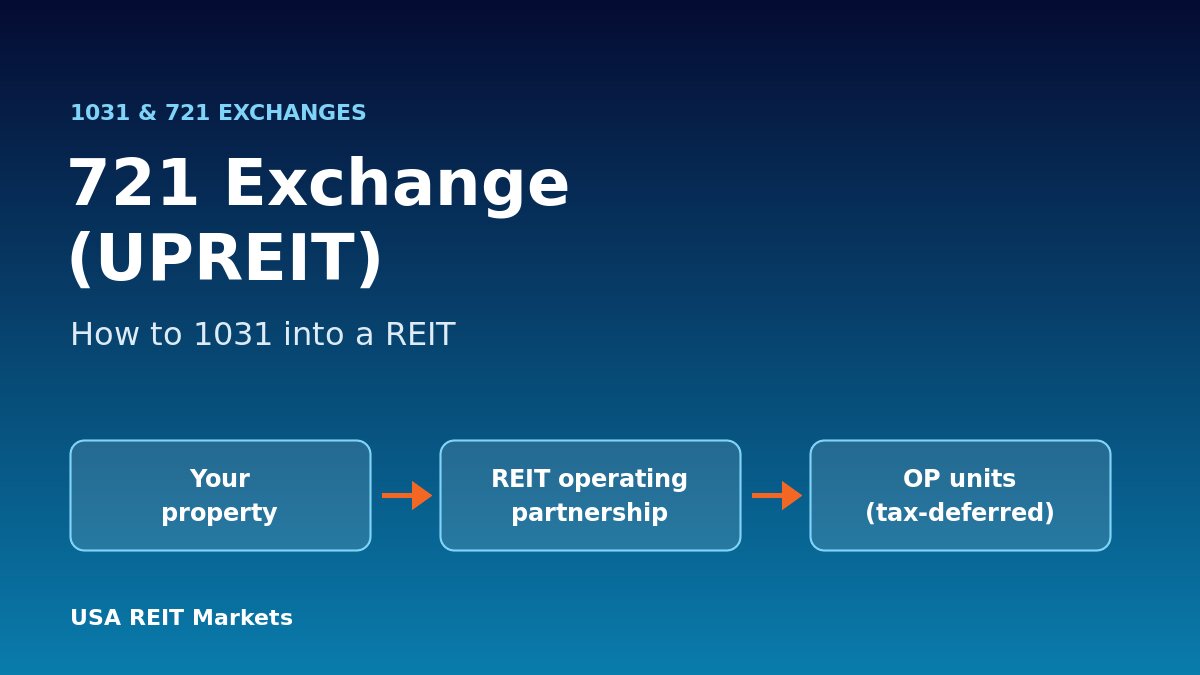
Short answer: You can't use a 1031 exchange to swap a rental property for REIT shares. REIT shares aren't "like-kind" real estate. What you can do is a 721 exchange: you contribute your property to a REIT's operating partnership and receive operating partnership units (OP units) instead of cash. Under Section 721 of the Internal Revenue Code, that contribution is generally tax-deferred. A REIT that holds its properties through an operating partnership like this is called an UPREIT (umbrella partnership real estate investment trust), which is why the deal is also known as an UPREIT exchange.
The trade-off is that a 721 exchange is usually a one-way door. Once you hold OP units, you can't 1031 exchange again, and converting or selling the units generally triggers the tax you deferred.
Why investors search for a "1031 exchange into a REIT"
Many property owners reach a point where they want out of active management (tenants, repairs, refinancing) but don't want a large capital gains tax bill from selling. A REIT looks like the natural next step: professionally managed, diversified, with regular distributions. A REIT also holds many properties, which spreads risk compared with owning one or two buildings.
The obstacle is the like-kind rule. A 1031 exchange only defers tax when you exchange real property for other real property held for investment or business use. Shares of a REIT are securities, not real property, so a direct 1031 exchange into REIT shares doesn't qualify. The 721 exchange is the workaround.
How a 721 exchange works
- You own investment real estate with an unrealized gain, either directly or through a Delaware statutory trust (see the DST route below).
- The REIT's operating partnership agrees to take the property. Not every REIT runs an UPREIT structure, and those that do only accept properties that fit their portfolio. Directly owned properties often have to be large enough and fit the REIT's strategy.
- You contribute the property to the operating partnership. In return you get OP units, usually valued so that one unit is economically equivalent to one REIT share.
- The contribution is generally tax-deferred under Section 721(a), which says no gain or loss is recognized when property is contributed to a partnership in exchange for a partnership interest. Your tax basis in the property carries over to your OP units.
- You receive distributions on your OP units, typically equal to the dividends paid on REIT shares.
- Later, you can usually redeem the units for REIT shares or cash, as set out in the partnership agreement. That redemption is generally the taxable event.
The DST route: 1031 first, 721 later
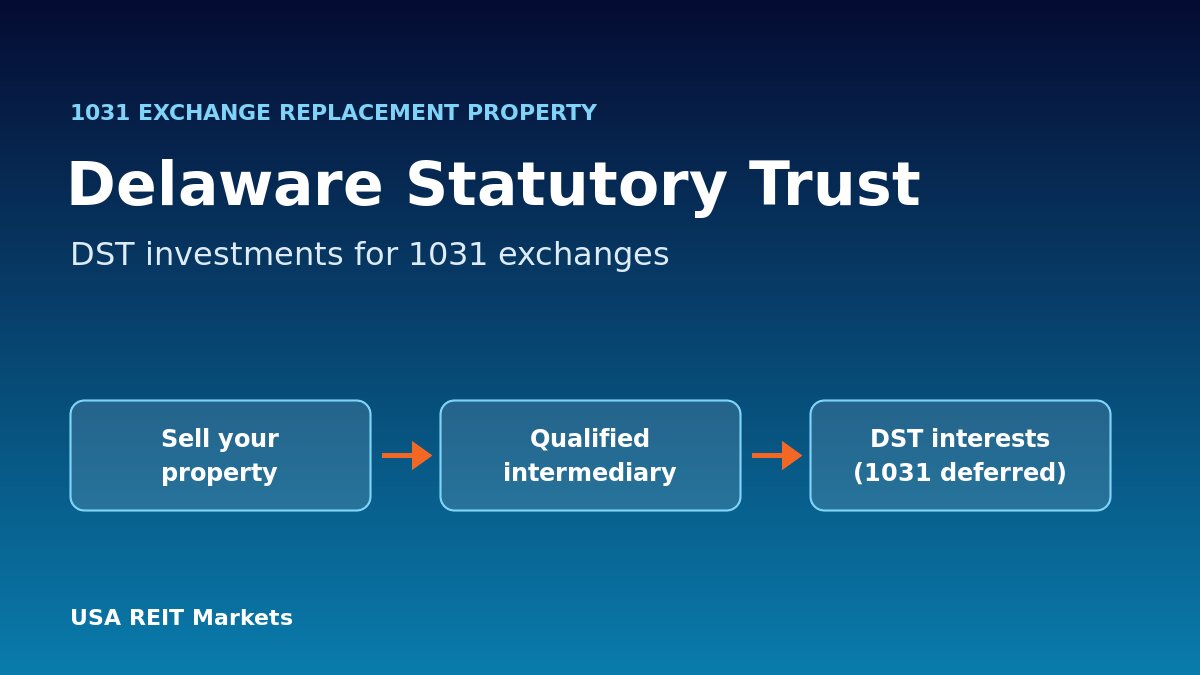
Most individual investors don't contribute their own building directly. A REIT may not want a single rental property, and the deal terms are hard to negotiate one-on-one. The more common path today runs through a Delaware statutory trust (DST):
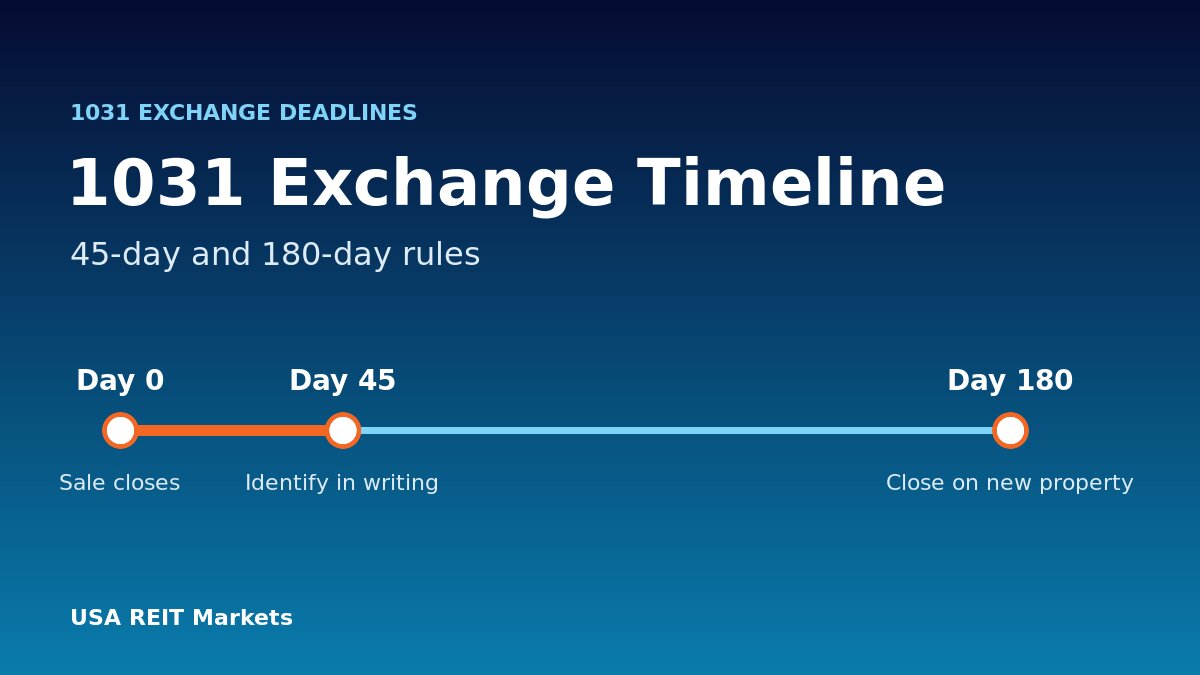
- Sell your property and complete a 1031 exchange into a DST. The IRS treats a qualifying DST interest as an interest in real estate for 1031 purposes (Revenue Ruling 2004-86), so the 1031 rules apply as usual: identify within 45 days, close within 180 days. Our 1031 exchange rules guide covers the deadlines.
- The DST holds the property for a period. Many DSTs are sponsored by a REIT and are built from the start with a planned 721 exit.
- The DST contributes its property to the sponsoring REIT's operating partnership, and DST investors receive OP units in a 721 exchange.
Read the DST's offering documents carefully on one point: is the 721 conversion optional or mandatory? In some programs the sponsor decides when the conversion happens and every investor goes into OP units. In others, each investor chooses at exit between OP units and another 1031 exchange. Once you hold OP units, the 1031 option is gone, so a forced conversion removes that choice.
721 exchange vs. 1031 exchange
| 1031 exchange | 721 exchange (UPREIT) | |
|---|---|---|
| What you give up | Real property | Real property (or DST interest) |
| What you receive | Other like-kind real property | Operating partnership units in a REIT |
| Tax on the swap | Deferred if the rules are met | Generally deferred under Section 721 |
| Deadlines | 45 days to identify, 180 days to close | Set by the deal; no statutory 45/180 window |
| Can you exchange again later? | Yes, you can keep doing 1031 exchanges | No. OP units can't be 1031 exchanged |
| Management | You (unless you buy a DST or similar) | REIT management |
| Diversification | Usually one or a few properties | Exposure to the REIT's whole portfolio |
| Liquidity | Sell the property | Redeem units per the partnership agreement (taxable) |
Benefits of a 721 exchange
- Tax deferral on the contribution, often on a gain that has built up over many years, including depreciation recapture.
- Diversification. One property becomes an interest in a portfolio spread across many buildings, tenants and markets.
- No more landlord duties. The REIT's managers run the properties.
- Income. OP units typically receive the same distributions per unit as REIT shares.
- Flexibility in timing. You can often redeem units in stages, spreading the tax across several years instead of taking it all at once.
- Estate planning. Under current law, assets held at death generally get a stepped-up tax basis for heirs (Section 1014). Investors often hold OP units for life for this reason. This is an area to confirm with your estate attorney, because the rules can change.
Risks and drawbacks
- The end of 1031 deferral. OP units aren't real property, so you can't roll them into another 1031 exchange. Your options from here are to hold, redeem (taxable) or pass the units to heirs.
- Redemption is taxable. Converting OP units into REIT shares or cash generally triggers the deferred gain, whether or not you then sell the shares.
- Debt can trigger tax. If you contribute a property with a mortgage and your share of liabilities goes down, the reduction can be treated as a cash distribution (Section 752) and create a taxable gain. Debt-heavy properties need careful structuring.
- Disguised sale rules. Cash or other payments around the time of the contribution can turn part of the deal into a taxable sale (Section 707). Contributors often negotiate a tax protection agreement, in which the operating partnership agrees to compensate them if it sells the contributed property or reduces debt in a way that triggers their tax.
- Loss of control. You no longer decide when properties are sold, refinanced or improved, and the REIT's decisions can create tax consequences for you.
- Valuation and fees. The number of OP units you receive depends on how the property and the REIT are valued. For non-traded REITs, the share value is set by the sponsor, not a market. Review the fees and the valuation method.
- Liquidity limits. Redemption rights may only start after a holding period, and non-traded REITs can limit or suspend redemptions.
- Market and concentration risk. You're now exposed to one REIT's strategy, leverage and management. As with any real estate investment, you can lose money.
Who a 721 exchange fits
A 721 exchange tends to suit owners who:
- have a large built-in gain and want to avoid paying the tax now;
- want to stop managing property but keep real estate income;
- don't plan to need the capital in a lump sum, and may hold the units for the long term or for their heirs;
- are comfortable giving up future 1031 flexibility.
It tends to fit poorly if you expect to need the money in a few years, want to keep trading up into bigger properties through 1031 exchanges, or own a property with debt that can't be kept in place.
Questions to ask before you commit
- Does the REIT run an UPREIT structure, and will it accept my property (or does my DST have a 721 option)?
- Is the conversion optional or mandatory?
- How will my property and the REIT units be valued, and what fees apply?
- When can I redeem units, for cash or shares, and are there limits?
- How will my mortgage be handled, and is there a tax protection agreement?
- What's my plan for the units: hold for income, redeem over time, or leave to heirs?
FAQ
What is a 721 exchange?
A transaction where you contribute real estate (or a DST interest) to a partnership, usually a REIT's operating partnership, in exchange for partnership units. Under Section 721 of the tax code, the contribution generally isn't taxed.
What does UPREIT stand for?
Umbrella partnership real estate investment trust: a REIT that owns its properties through an operating partnership, which allows property owners to contribute real estate for OP units.
Can I do a 1031 exchange directly into a REIT?
Not into REIT shares. They aren't like-kind real property. You can 1031 into a DST, and some DSTs later convert into a REIT's operating partnership through a 721 exchange.
Is a 721 exchange tax-free?
It's tax-deferred, not tax-free. The gain carries over to your OP units and is generally taxed when you redeem or sell them. Holding them until death may change the outcome for heirs under current law.
Can I do another 1031 exchange after a 721 exchange?
No. OP units are partnership interests, not real property, so they can't be exchanged under Section 1031.
What's the difference between a DST and a 721 exchange?
A DST is a way to own a fractional interest in specific real estate that qualifies for a 1031 exchange. A 721 exchange converts real estate or a DST interest into units of a REIT's operating partnership. Many investors use both, one after the other.
Next steps
If you're weighing what to do with an appreciated property, start with the 1031 exchange rules and compare your options on our 1031 exchange page. You can also browse current opportunities on the USA REIT marketplace or contact our team.
This article is for general information only and is not tax, legal or investment advice. 721 and 1031 exchanges have complex rules, and the outcome depends on your situation. Talk to a qualified tax adviser and attorney before acting. Private real estate investments carry risk, may be illiquid, and some are available only to accredited investors.
Latest Articles