
How to Invest in Commercial Real Estate: 8 Ways Compared
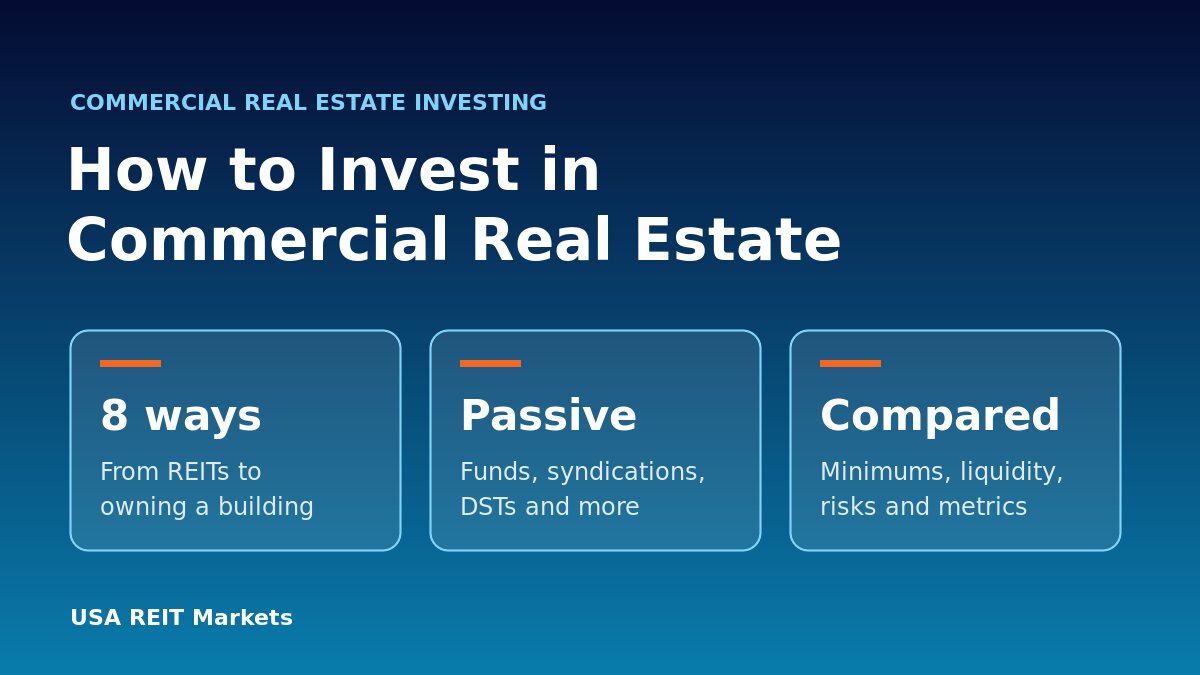
Short answer: You can invest in commercial real estate by buying a property yourself, or by investing alongside others through REITs, private funds, syndications, Delaware statutory trusts and online offerings. The right way depends on four things: how much money you want to put in, how soon you might need it back, how involved you want to be, and whether you're an accredited investor.
Here are the eight main ways, from most liquid to most hands-on:
- Publicly traded REITs and REIT funds: buy shares on a stock exchange.
- Non-traded and private REITs: REIT shares that aren't listed, with limited ways to sell.
- Commercial real estate funds: a manager pools investors' money into a portfolio of properties.
- Real estate syndications: invest with a sponsor in one specific property.
- Online real estate offerings: private offerings sold through investment platforms under Regulation D, Regulation A+ or Regulation Crowdfunding.
- Delaware statutory trusts (DSTs): fractional ownership of large properties, often used for 1031 exchanges.
- Tokenized real estate: digital securities representing shares of real estate.
- Buying a commercial property directly: you own, finance and manage it yourself.
What counts as commercial real estate?
Commercial real estate (CRE) is property used to earn income from businesses or from renting to many tenants, rather than a home you live in. The main types:
- Multifamily: apartment buildings. Properties with five or more units are generally financed and valued as commercial real estate.
- Industrial: warehouses, distribution centers, manufacturing and flex space.
- Office: from downtown towers to suburban and medical office buildings.
- Retail: shopping centers, strip malls and single-tenant stores such as pharmacies and restaurants.
- Hospitality: hotels and resorts, where income changes nightly with demand.
- Specialty: self-storage, data centers, senior housing, student housing, life science labs and land.
Each type has its own drivers. Industrial demand follows e-commerce and supply chains, office demand follows how people work, and hotels follow travel. Many investors spread their money across types and locations instead of betting on one. For markets, see our guide to the top US cities for commercial property investment.
Is commercial real estate a good investment?
It can be, for the right investor and the right deal. What draws people to it:
- Income: commercial properties are usually leased to businesses, often on multi-year leases, which can produce steady cash flow.
- Diversification: private real estate doesn't move in step with the stock market day to day.
- Inflation protection: rents and property values have tended to rise with inflation over long periods, though not every year.
- Tax benefits: depreciation can shelter part of the income, and a 1031 exchange can defer tax when you sell.
And the risks:
- Illiquidity: most ways to invest, apart from public REITs, tie your money up for years.
- Interest rates: higher rates raise borrowing costs and can push property values down.
- Vacancy and tenants: losing a major tenant can cut income sharply.
- Leverage: debt magnifies gains and losses.
- Manager risk: with any pooled investment, results depend heavily on the sponsor or manager.
No return is guaranteed, and past results don't predict future ones.
1. Publicly traded REITs and REIT funds
A real estate investment trust (REIT) is a company that owns or finances income-producing property and pays out most of its taxable income as dividends. Publicly traded REITs are listed on stock exchanges, and REIT mutual funds and ETFs hold many of them at once.
- Minimum: the price of one share or fund unit.
- Liquidity: sell any trading day.
- Involvement: none.
- Who can invest: anyone with a brokerage account.
This is the simplest way to get commercial real estate exposure. The trade-off is that REIT shares move with the stock market, sometimes sharply. Read what a REIT is and how it works.
2. Non-traded and private REITs
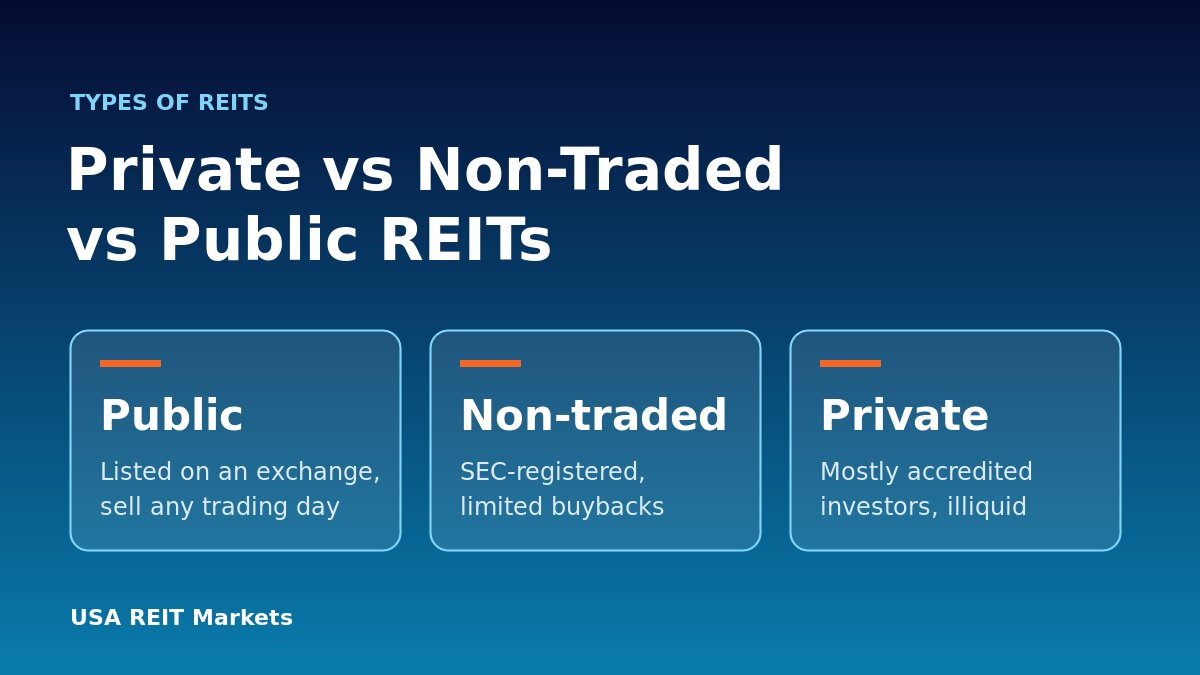
Some REITs aren't listed on an exchange. Public non-traded REITs are registered with the SEC and sold through brokers and advisers; private REITs are sold in private offerings, mostly to accredited investors.
- Minimum: from a few thousand dollars for non-traded REITs to tens of thousands or more for private REITs.
- Liquidity: limited. Repurchase programs are capped and can be suspended.
- Involvement: none.
- Who can invest: non-traded REITs are open to investors who meet state suitability standards; private REITs are mostly for accredited investors.
Prices don't swing daily like a stock, but fees can be significant and getting your money out may take time. See our comparison of private, non-traded and public REITs.
3. Commercial real estate funds
A commercial real estate fund pools money from many investors and a professional manager buys a portfolio of properties. Funds may focus on one strategy (for example, industrial properties in growing markets) or spread across types and regions.
- Minimum: often $25,000 or more for private funds; lower for some interval funds and Reg A+ funds.
- Liquidity: private funds usually run for a set term, often several years; some open-ended funds offer periodic redemptions.
- Involvement: none.
- Who can invest: usually accredited investors, except funds offered under Regulation A+ or registered with the SEC.
A fund gives you diversification across properties in one investment. You rely on the manager to pick and run the properties, so the manager's track record and fees matter most. Browse commercial real estate funds.
4. Real estate syndications
In a syndication, a sponsor finds a specific property (say, an apartment complex or a warehouse), arranges the financing and manages it, and investors put in most of the equity. Investors are usually limited partners or LLC members; the sponsor earns fees and a share of the profits.
- Minimum: often $25,000 to $100,000.
- Liquidity: low. Plan to hold until the property is sold, often 3 to 10 years.
- Involvement: none after you invest, but you need to vet the deal and the sponsor.
- Who can invest: usually accredited investors.
You know exactly what you own, and the sponsor's interests are tied to the property's results. The risk is concentrated in one property and one sponsor. Read how real estate syndication works and the role of the sponsor.
5. Online real estate offerings
Investment platforms and marketplaces list private real estate offerings online: syndications, funds and REITs that you can review and invest in from your computer. The rules depend on how each offering is structured:
- Regulation D: most private deals, generally for accredited investors only. Offerings under Rule 506(c) can advertise publicly but must verify that every investor is accredited.
- Regulation A+: offerings open to the general public, including non-accredited investors, with limits on how much non-accredited investors can put into the larger Tier 2 offerings. Learn more about Reg A offerings.
- Regulation Crowdfunding (Reg CF): smaller raises through registered funding portals, open to everyone, with yearly limits for non-accredited investors.
An accredited investor (as an individual) generally has income over $200,000 ($300,000 with a spouse or partner) in each of the past two years, or a net worth over $1 million not counting their home, or holds certain securities licenses.
Platforms make private deals easier to find and compare, and some let you start with smaller amounts. The platform isn't your adviser: read each offering's documents, and check who the sponsor is and how the platform is paid. You can compare current offerings on the USA REIT marketplace.
6. Delaware statutory trusts (DSTs)
A DST is a trust that owns one or more large properties, and investors buy fractional, passive interests in it. DST interests qualify as replacement property in a 1031 exchange, so they're popular with property owners who want to sell, defer tax and stop managing real estate.
- Minimum: often $25,000 to $100,000.
- Liquidity: low, typically held 5 to 10 years until the properties are sold.
- Involvement: none.
- Who can invest: generally accredited investors.
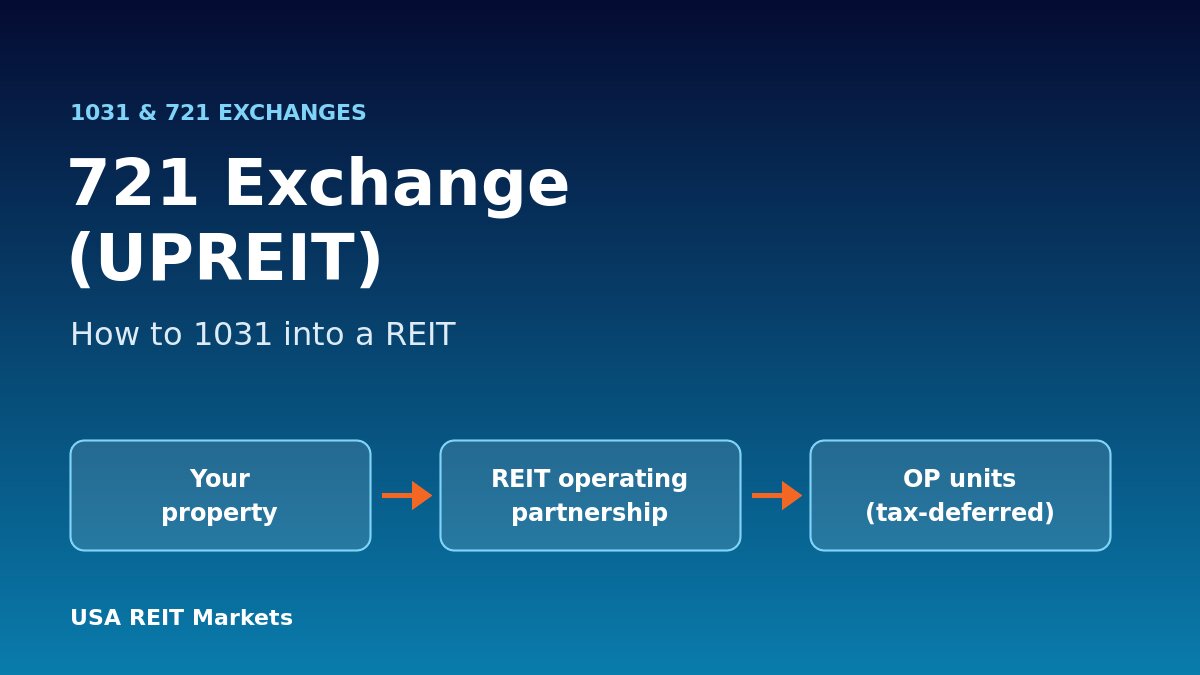
Read our guide to Delaware statutory trust investments, and see the 721 exchange if you're considering a later move into a REIT.
7. Tokenized real estate
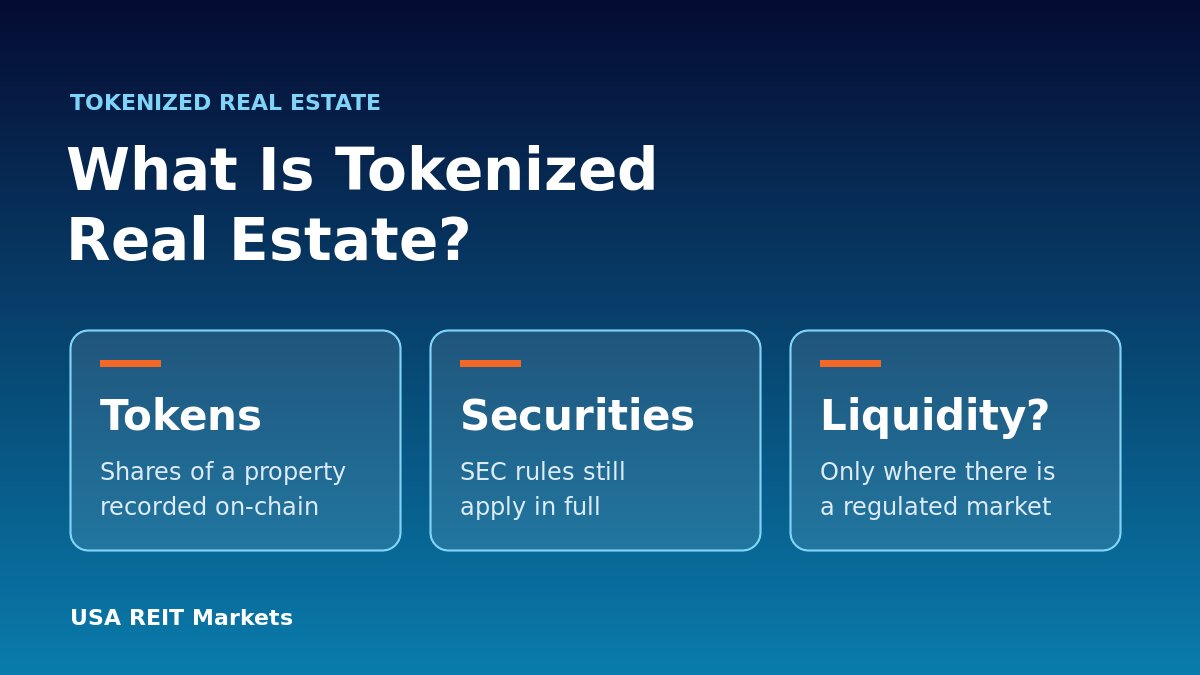
Tokenization records ownership of real estate securities, such as shares in a property-owning company or fund, as digital tokens on a blockchain. The goal is to make ownership easier to divide into small pieces, transfer and, in time, trade on regulated secondary markets.
Tokenized real estate is still real estate securities: the same securities laws, investor limits and property risks apply. Liquidity depends on whether a regulated trading venue actually exists for the tokens. Read what tokenized real estate is and how real estate tokens work, or learn about tokenized real estate on USA REIT Markets.
8. Buying a commercial property directly
You can buy a commercial building yourself, alone or with partners through an LLC. Many first-time buyers start with a small property: a small apartment building, a mixed-use building with shops below and apartments above, or a single-tenant property on a triple-net (NNN) lease, where the tenant pays taxes, insurance and maintenance.
- Minimum: the down payment. Commercial loans often require 20% to 35% down, plus closing costs and reserves.
- Liquidity: low. Selling a building takes months.
- Involvement: high, unless you hire a property manager.
- Who can invest: anyone who can buy and finance the property.
You get full control and keep all the upside, plus depreciation and the option of a 1031 exchange when you sell. You also carry all the risk, the work and often a personal guarantee on the loan.
The 8 ways at a glance
| Way to invest | Typical minimum | Liquidity | Your involvement | Who can invest |
|---|---|---|---|---|
| Public REITs and REIT funds | One share | High (daily) | None | Anyone |
| Non-traded and private REITs | A few thousand dollars and up | Limited | None | Suitability standards; private REITs mostly accredited |
| Commercial real estate funds | Often $25,000+ | Low to limited | None | Mostly accredited (Reg A+ funds open to all) |
| Syndications | Often $25,000 to $100,000 | Low (3 to 10 years) | Vet the deal, then none | Mostly accredited |
| Online offerings | Varies by offering | Low | Vet the deal, then none | Reg D accredited; Reg A+ and Reg CF open to all |
| DSTs | Often $25,000 to $100,000 | Low (5 to 10 years) | None | Mostly accredited |
| Tokenized real estate | Varies | Depends on a trading venue | None | Depends on the offering |
| Buying a property | 20% to 35% down plus costs | Low | High | Anyone who can finance it |
Key numbers every commercial real estate investor should know
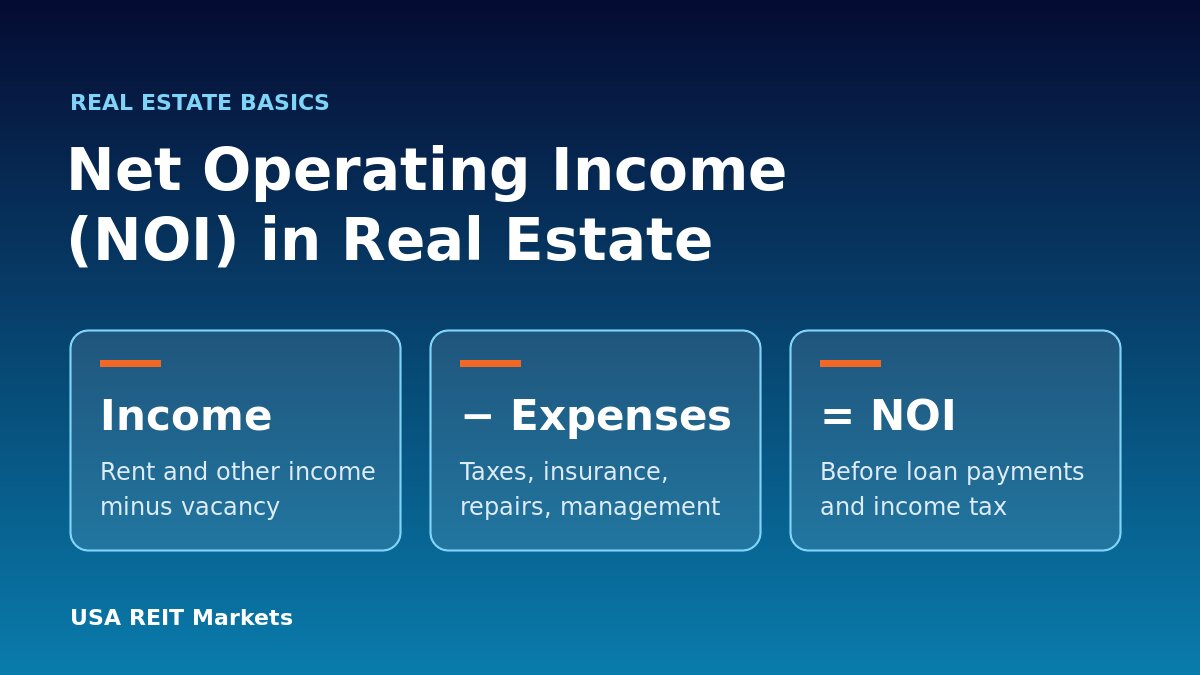
- Net operating income (NOI): rent and other income minus operating expenses, before loan payments and income tax. See how to calculate NOI.
- Cap rate: NOI divided by the property's price. A $2,000,000 building with $120,000 of NOI has a 6% cap rate. Higher cap rates mean more income per dollar, usually with more risk or less growth; lower cap rates usually mean safer or faster-growing properties and markets. Work out NOI, cap rate and cash-on-cash return with our cap rate calculator.
- Cash-on-cash return: yearly cash flow after loan payments divided by the cash you invested.
- Loan-to-value (LTV): the loan amount as a share of the property's value. More debt means more risk.
- Debt service coverage ratio (DSCR): NOI divided by annual loan payments. Lenders usually want comfortably more than 1.0.
- Internal rate of return (IRR) and equity multiple: the two figures sponsors most often use to project a deal's total return over its life. Treat projections as estimates, not promises, and ask what assumptions drive them.
- Lease terms: how long the leases run, who pays which expenses, and how strong the tenants are.
How to start investing in commercial real estate
- Set your goal: income now, growth over time, or tax deferral from selling another property.
- Decide how hands-on you want to be: active ownership, or passive investing through REITs, funds, syndications or DSTs.
- Decide how long you can tie up the money: if you might need it within a few years, favor public REITs.
- Check whether you're an accredited investor: it determines which private offerings you can join.
- Pick a strategy: core (stable, fully leased properties), value-add (properties that need improvement or re-leasing) or development (building new), from lower to higher risk.
- Do your due diligence: use the checklist below for every offering.
- Start small and diversify: spread money across properties, property types, sponsors and years instead of putting it all into one deal.
Due diligence checklist for passive investments
- Who is the sponsor or manager, how long have they operated, and how did their past deals turn out?
- What exactly will you own, and in which market?
- What are all the fees: acquisition, asset management, disposition and the sponsor's share of profits?
- How much debt is used, at what rate, and when does it need to be refinanced?
- What assumptions drive the projected returns: rent growth, occupancy, exit cap rate?
- How long is the expected hold, and is there any way to sell early?
- How much is the sponsor investing alongside you?
- What reports and tax documents will you receive (for example, a Schedule K-1)?
How commercial real estate investments are taxed
- Owning property directly or through a syndication or fund: you generally receive your share of income, depreciation and gains. Depreciation can offset part of the income, and syndications and funds usually report it on a Schedule K-1.
- REITs: most dividends are taxed as ordinary income, with a 20% deduction for qualified REIT dividends.
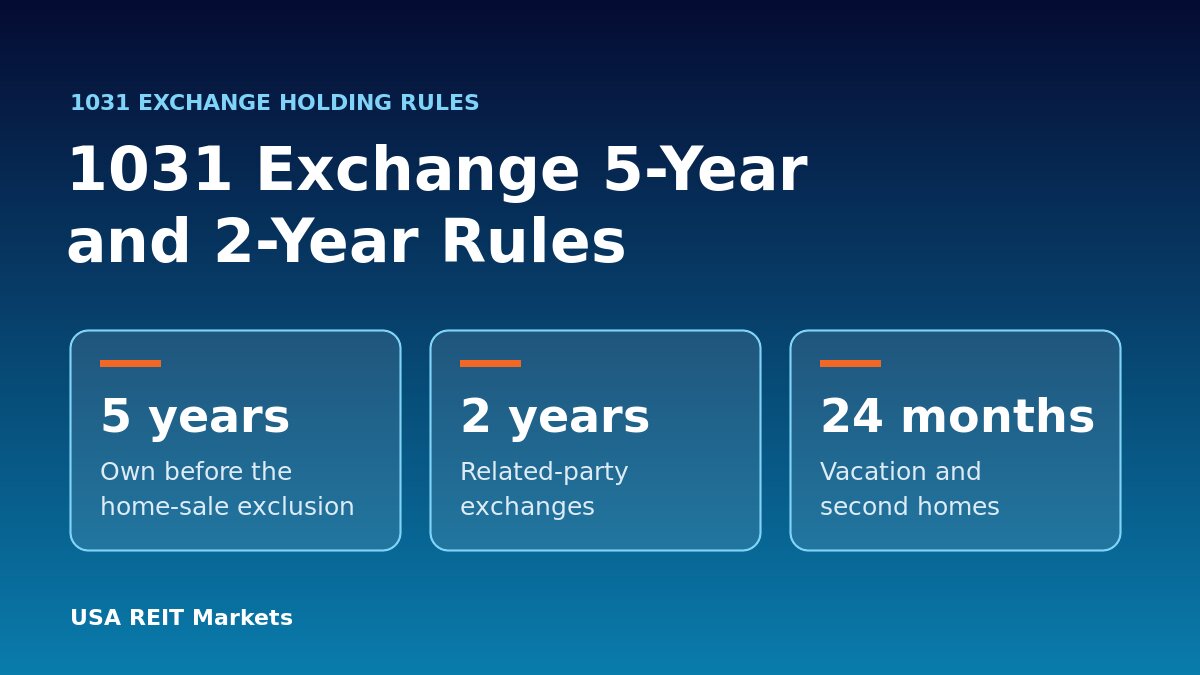
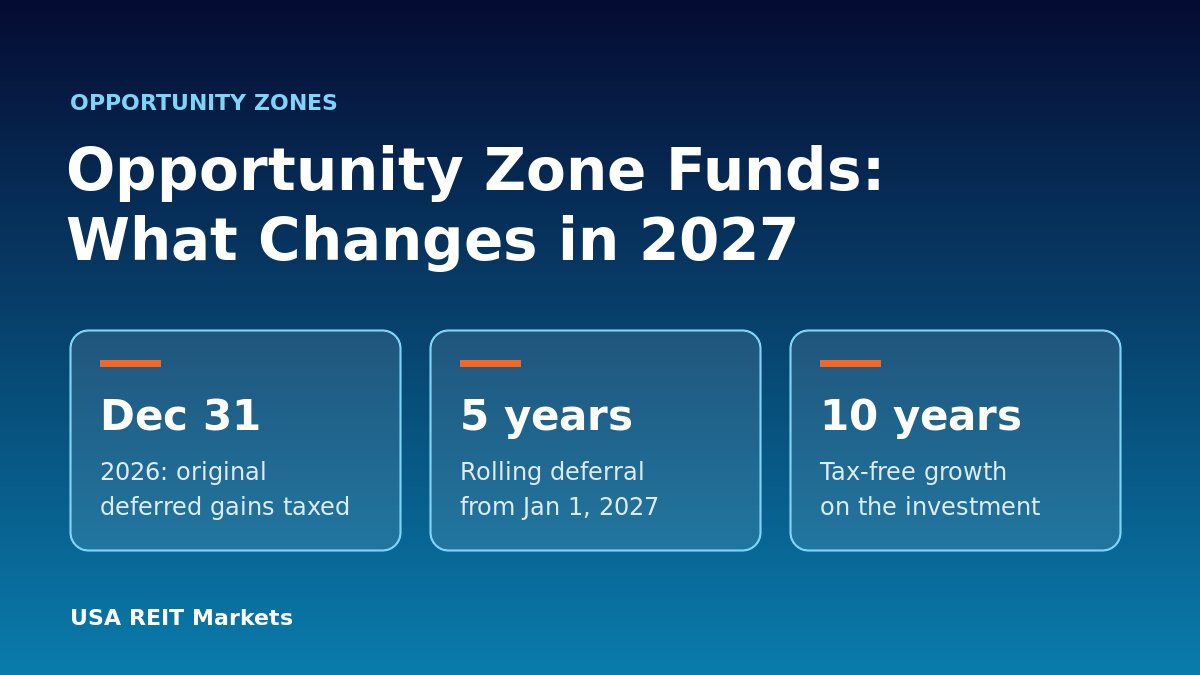
- Selling: gains are generally taxed as capital gains, with depreciation recapture taxed at up to 25%. A 1031 exchange into another property or a DST can defer the tax. See our 1031 exchange page. For gains from any asset, opportunity zone funds offer a different kind of deferral.
Talk to a tax adviser about your situation.
FAQ
How can I invest in commercial real estate with little money?
Publicly traded REITs and REIT funds let you start with the price of one share. Some non-traded REITs and Regulation A+ or crowdfunding offerings have minimums of a few hundred or a few thousand dollars, with less liquidity.
Is commercial real estate a good investment?
It can offer income, diversification and some protection against inflation, but it also carries risks: illiquidity, interest-rate changes, vacancies, leverage and dependence on the manager. It works best as part of a diversified portfolio, with money you won't need soon.
What is passive commercial real estate investing?
Investing without managing property yourself: through REITs, real estate funds, syndications, DSTs or online offerings, where a sponsor or manager runs the properties and you receive your share of the income and profits.
Do I need to be an accredited investor?
Not for public REITs, most non-traded REITs, Regulation A+ offerings or crowdfunding. Most private syndications, private funds, DSTs and Regulation D offerings are limited to accredited investors.
What is a good cap rate for commercial real estate?
There's no single number. Cap rates vary by property type, location, tenant quality and interest rates. Compare a property's cap rate with similar properties in the same market, and remember that a higher cap rate usually comes with higher risk.
What are the main types of commercial real estate?
Multifamily, industrial, office, retail and hospitality, plus specialty types like self-storage, data centers, senior and student housing, and land.
How long do commercial real estate investments last?
Public REITs can be sold any day. Syndications, private funds and DSTs typically run 3 to 10 years. Direct ownership lasts as long as you choose to hold.
Next steps
Compare current private commercial real estate offerings on the USA REIT marketplace, explore commercial real estate funds and Reg A offerings, or read our introduction to private real estate. Questions? Contact our team.
This article is for general information only and is not investment, tax or legal advice, or an offer to sell any security. Real estate investments carry risk, including loss of principal. Private offerings are illiquid, are generally available only to accredited investors, and should be considered only after reading the offering documents and speaking with a financial adviser.
Latest Articles