
506(b) vs 506(c): Which Reg D Exemption Fits Your Real Estate Raise?
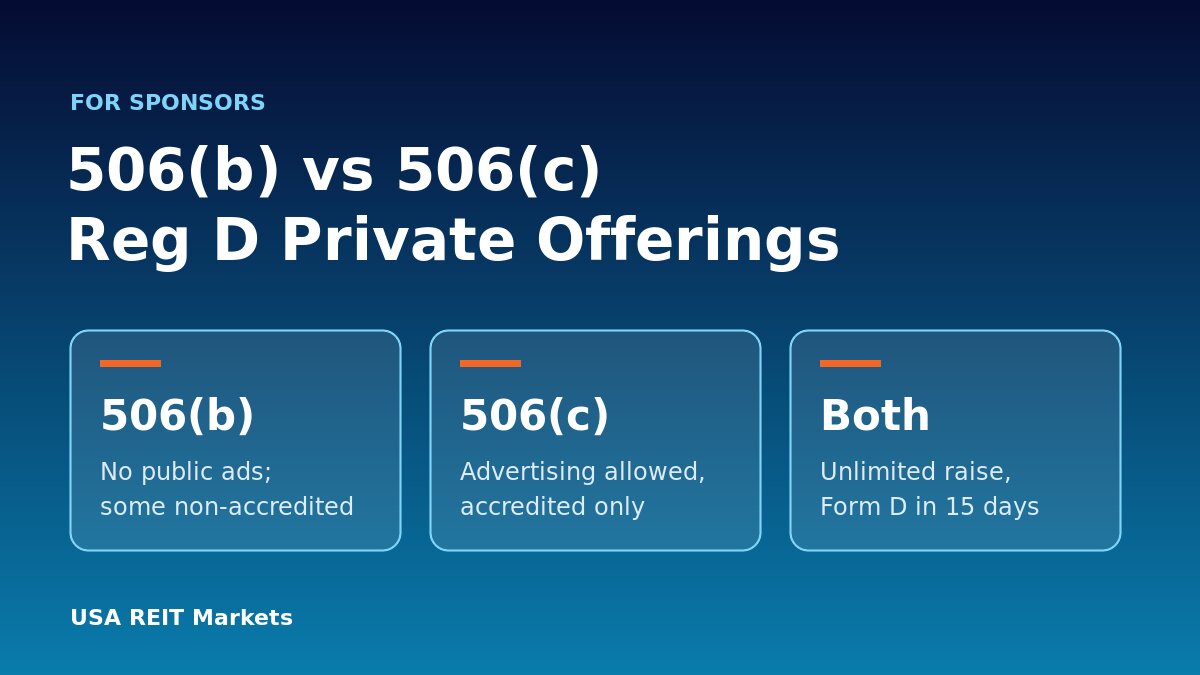
Short answer: Rule 506(b) and Rule 506(c) are the two main ways to raise money privately under SEC Regulation D without registering the offering. Under 506(b) you can't advertise or publicly solicit investors, but you can accept up to 35 non-accredited investors who are financially sophisticated. Under 506(c) you can advertise publicly, but every investor must be accredited and you must take reasonable steps to verify that they are. Both let you raise an unlimited amount of money.
Most real estate syndications, private funds and Delaware statutory trusts (DSTs) in the US are offered under one of these two rules. Which one a sponsor picks shapes how it can market the deal, who can invest, and what investors have to provide before they can invest.
506(b) vs 506(c) at a glance
| Rule 506(b) | Rule 506(c) | |
|---|---|---|
| General solicitation and advertising | Not allowed | Allowed |
| Accredited investors | Unlimited | Unlimited |
| Non-accredited investors | Up to 35 in any 90-day period, each financially sophisticated (alone or with a purchaser representative) | Not allowed |
| Checking accredited status | Reasonable belief; investor questionnaires and self-certification are common | Issuer must take reasonable steps to verify each investor |
| Disclosure to investors | If any non-accredited investor participates, they must get disclosure documents similar to a registered offering, including financial statements | No specific disclosure is required by Reg D, but anti-fraud rules still apply and offering memoranda are standard |
| How much can be raised | No limit | No limit |
| Form D | File with the SEC within 15 days after the first sale | File with the SEC within 15 days after the first sale |
| State registration | Preempted; states can require notice filings and fees | Preempted; states can require notice filings and fees |
| Resale | Restricted securities | Restricted securities |
What Rule 506(b) allows
Rule 506(b) is the older and still the most widely used exemption. Its defining limit is that the sponsor can't use general solicitation: no public advertising, no open webinars, no public social media posts about the offering, and no outreach to people the sponsor has no relationship with.
In practice, 506(b) sponsors raise from people they already know. The SEC treats a pre-existing, substantive relationship (one formed before the offering, where the sponsor has enough information to judge the investor's financial situation and sophistication) as a way to show that an investor wasn't reached by general solicitation. Many sponsors build these relationships over time through investor sign-ups, calls and questionnaires before showing anyone a specific deal.
Who can invest: any number of accredited investors, plus up to 35 non-accredited investors in any 90-day period. Each non-accredited investor must have enough knowledge and experience in financial matters to evaluate the investment, either alone or with a purchaser representative.
Disclosure: if even one non-accredited investor participates, the sponsor must give non-accredited investors disclosure documents generally similar to those in a registered or Regulation A offering, including financial statement information, and must be available to answer their questions. Because that's costly, many 506(b) real estate deals accept accredited investors only, even though the rule would allow some non-accredited investors.
Checking accredited status: the sponsor must reasonably believe each investor is accredited. Investor questionnaires and written self-certification are the usual tools.
What Rule 506(c) allows
Rule 506(c) took effect in 2013 under the JOBS Act. It lets sponsors advertise an offering publicly: on their website, in online ads, on social media, in podcasts and at public events, as long as two conditions are met:
- Every purchaser is an accredited investor. Non-accredited investors can't invest at all.
- The sponsor takes reasonable steps to verify that each purchaser is accredited. Self-certification alone has traditionally not been enough.
How accredited investor verification works
The rule lists several methods that the SEC treats as satisfying the verification requirement, though sponsors can use other reasonable methods:
- Income: reviewing IRS forms (such as W-2s, 1099s, K-1s or tax returns) for the two most recent years, plus a written statement that the investor expects to reach the income level again this year.
- Net worth: reviewing recent bank, brokerage or other account statements and a credit report (generally dated within the prior three months), plus a written statement that all liabilities have been disclosed.
- Third-party letter: a written confirmation from a registered broker-dealer, an SEC-registered investment adviser, a licensed attorney or a certified public accountant that they have taken reasonable steps to verify the investor's status within the prior three months.
- Existing investors: for someone who invested in an earlier 506(b) offering by the same issuer as an accredited investor, a written certification at the time of the new sale.
Many sponsors use an online verification service or ask the investor's CPA or attorney for a letter.
High minimum investments (SEC staff letter, March 2025)
On March 12, 2025, SEC staff issued a no-action letter and updated guidance saying an issuer can generally treat high minimum investments as reasonable steps to verify accredited status. The letter set these terms:
- a minimum investment of at least $200,000 for individuals or $1,000,000 for entities (with different amounts for some entities owned by individuals);
- written representations from the investor that they are accredited and that the minimum investment isn't financed by a third party; and
- no knowledge by the issuer of facts suggesting otherwise.
This makes 506(c) much simpler for offerings with large minimum investments. For offerings with lower minimums, the traditional verification methods still apply.
Who counts as an accredited investor
Both rules depend on the SEC's definition of an accredited investor in Rule 501(a). For individuals, the main tests are:
- Income: more than $200,000 in each of the two most recent years ($300,000 together with a spouse or spousal equivalent), with a reasonable expectation of the same this year.
- Net worth: more than $1 million, alone or with a spouse or spousal equivalent, not counting the value of the primary residence.
- Professional credentials: holding a Series 7, Series 65 or Series 82 license in good standing.
- Knowledgeable employees of a private fund, for investments in that fund.
Entities can qualify too, for example with more than $5 million in assets (if not formed to make the investment), or if all of their equity owners are accredited. The SEC has reviewed this definition several times, so check the current rule before relying on these thresholds.
How sponsors choose between 506(b) and 506(c)
| Choose 506(b) if... | Choose 506(c) if... |
|---|---|
| You already have a network of investors who know you | You need to reach new investors you don't yet know |
| You want to include a few sophisticated non-accredited investors (friends, family, employees) and can provide the required disclosure | Your investors are all accredited and you want to market openly |
| Your investors would push back on providing tax returns or account statements | Your minimum investment is high enough to use the March 2025 approach, or investors accept verification |
| You don't plan to advertise the offering | You plan to use a website, online ads, social media, email to cold lists or a public listing on an investment platform |
A few practical points:
- Marketing changes the answer. Posting a specific offering on a public website, running ads or talking about it on a podcast is general solicitation. Once you've done that, the offering generally can't rely on 506(b).
- Switching from 506(b) to 506(c) during an offering is generally possible going forward, as long as every investor from that point is accredited and verified. Going the other way, from 506(c) back to 506(b) after public marketing, is much harder.
- Bad actor rules apply to both. Rule 506(d) disqualifies an offering if the issuer or certain related people (such as directors, officers, large owners and paid solicitors) have specified securities-law violations or sanctions.
- Form D tells regulators which rule you used. It's filed on the SEC's EDGAR system and is public, so the choice is visible to anyone who looks.
- Paying people to bring in investors generally requires them to be registered broker-dealers. Unregistered finders are a common compliance problem in both kinds of offerings.
What it means for investors
- In a 506(b) deal, you usually hear about the offering because you already have a relationship with the sponsor or a broker-dealer. You'll typically complete a questionnaire confirming you're accredited (or, if allowed, sophisticated).
- In a 506(c) deal, you may see the offering advertised publicly, but you'll need to prove you're accredited: with tax documents, account statements, a letter from your CPA, attorney or adviser, or, for large investments, the minimum-investment representations described above.
- In both, the securities are restricted and usually can't be resold easily. Private placements aren't reviewed or approved by the SEC, so read the offering documents, risk factors and fees carefully. Learn more about how real estate syndication works and the other ways to invest in commercial real estate and multifamily properties.
Other options beyond Rule 506
- Regulation A (Reg A+) allows public offerings of up to $75 million a year (Tier 2) to both accredited and non-accredited investors, with an SEC-qualified offering circular, ongoing reporting and, for non-accredited investors in Tier 2, investment limits. Read more about Regulation A+ offerings.
- Regulation Crowdfunding (Reg CF) allows raises of up to $5 million a year through a registered funding portal or broker-dealer, open to the public with investment limits.
- Rule 504 allows up to $10 million in a 12-month period, but it generally doesn't preempt state securities registration, so it's less common for multi-state real estate raises.
Each option has different costs, timelines and marketing rules. Many sponsors use Rule 506 for single deals with accredited investors and consider Reg A+ when they want to include non-accredited investors at scale.
Frequently asked questions
What is the main difference between 506(b) and 506(c)?
506(b) prohibits general solicitation but allows up to 35 sophisticated non-accredited investors. 506(c) allows general solicitation but only accredited investors, whose status must be verified.
Can I advertise a 506(b) offering?
No. Rule 506(b) doesn't allow general solicitation or general advertising of the offering. Sponsors can still build their brand and relationships, but they can't publicly promote a specific offering.
Can non-accredited investors invest in a 506(c) offering?
No. Every purchaser in a 506(c) offering must be an accredited investor, and the issuer must take reasonable steps to verify that status.
Is self-certification enough for 506(c)?
Generally not on its own. Since March 2025, SEC staff guidance allows written representations combined with high minimum investments ($200,000 for individuals, $1 million for entities) and no contrary information. Otherwise, sponsors use income or net worth documents or a third-party verification letter.
Is there a limit on how much money can be raised under Rule 506?
No. Both 506(b) and 506(c) allow an unlimited amount to be raised.
Do I have to file anything with the SEC?
Yes. Issuers file a Form D notice with the SEC within 15 days after the first sale, and many states require notice filings and fees.
Next steps
Raising capital for a real estate project? See how sponsors raise capital and list offerings on USA REIT Markets, or contact our team. Investors can browse current offerings on the USA REIT marketplace.
This article is for general information only and is not legal, tax or investment advice. Securities laws are complex and change over time, and the right exemption depends on the facts of each offering. Consult qualified securities counsel before conducting an offering. Private placements are speculative, illiquid and may result in the loss of your entire investment.
Latest Articles