Macroeconomic Foundations
The Lumicre Strategic Fund I LLC Investment Thesis
Our fund has a simple thesis. We buy and build future-proofed warehouses in Texas.
This simple strategy is intellectually rigorous. It relies on undeniable macroeconomic facts. It is designed to maximize enterprise value. We execute this over the next several years, as the trends are enduring. We mitigate risks through strict underwriting. We create massive long-term value. We utilize a blue ocean strategy. We avoid crowded, hyper-competitive real estate markets. We forge uncontested market space instead. We build assets the economy desperately needs.
We rely on verified economic trends. Our foundation is built on heavy power. It is built on global trade. It is built on automation. It is built on the unstoppable growth of Texas.
The 25-Year Texas Economic Boom
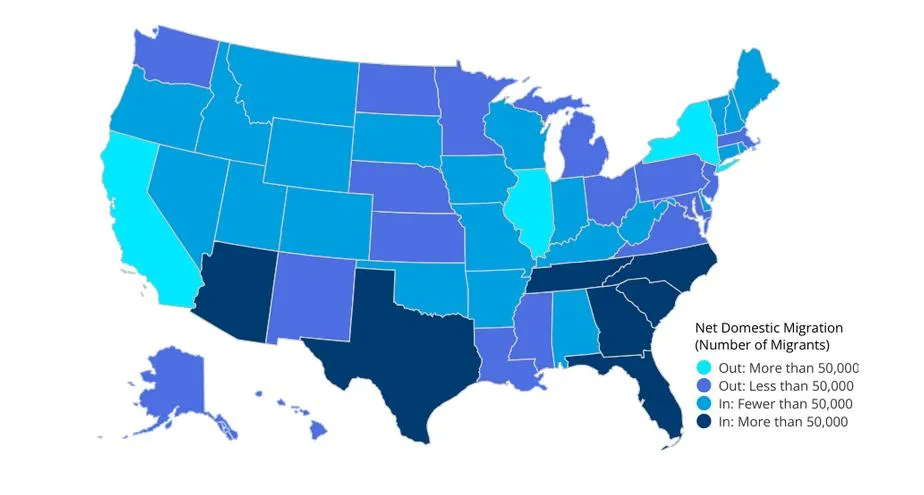
Texas is experiencing a profound transformation. The state is growing rapidly. It leads the nation in growth. This is not a short-term trend. It is a sustained economic expansion. We expect a massive 25-year boom. This boom will likely stretch from 2025 to 2050. The data is clear and compelling.
The Texas Demographic Center provides startling projections. The state population was 31.7 million in 2025. It will not stop growing. By 2040, it will reach 39.1 million residents. By 2060, it will hit 42.6 million. This is explosive, sustained human growth. This population requires massive amounts of goods. Goods require advanced logistics nodes. They require last-mile distribution centers, pre-agentic logistics, highly automated logistics, and perhaps 5-10X more power than current industrial real estate inventory can offer.
The Perryman Group forecasts equally robust economic expansion. Real gross product will grow 3.27 percent annually. Over the next 30 years, output will surge. The manufacturing sector alone will add billions in value. Texas consistently attracts major corporate relocations. It attracts massive capital investments. The state possesses strategic advantages in advanced manufacturing. It leads in financial services and life sciences.
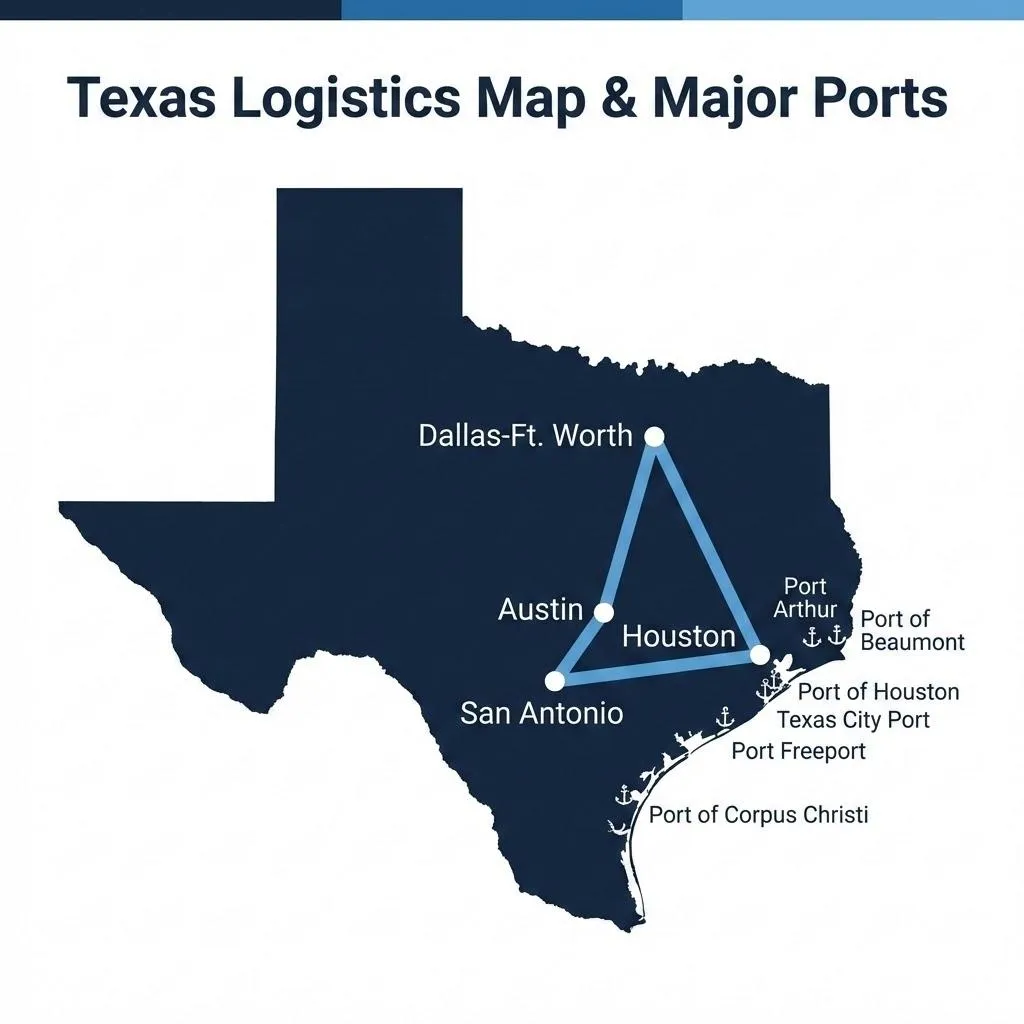
Most of this growth is highly concentrated. It occurs within the Texas Triangle. This region connects Dallas-Fort Worth, Houston, San Antonio, and Austin.
The Texas Triangle
The foundation of the Lumicre investment strategy is inextricably linked to undeniable macroeconomic realities within the state of Texas. Investors frequently make decisions driven by emotional desires for security and legacy, yet they seek to justify those decisions through rigorous empirical data. The foundational thesis of the firm—"We buy and build future-proofed warehouses in Texas"—is validated by the economic performance of the Texas Triangle, the megaregion encompassing Houston, Dallas-Fort Worth, and San Antonio.
This region accounts for approximately 80% of the state's gross domestic product and is home to over 22.5 million residents. When evaluated as a sovereign economic entity, the Texas Triangle's output of over $1.3 trillion would rank it as the twelfth largest economy globally, rivaling the economic stature of nations such as Australia or Mexico. This scale provides a defensive buffer against localized downturns and creates a self-reinforcing cycle of growth, investment, and demand for industrial infrastructure.
Key Economic Indicators
| Texas Triangle GDP |
Over $1.3 trillion (approx. 80% of state GDP) |
| Population (Texas Triangle) |
Over 22.5 million residents |
| Projected State Population (2040) |
39.1 million |
| Projected State Population (2060) |
42.6 million |
| Real Gross Product Growth |
3.27% annually (Perryman Group forecast) |
Industrial Real Estate Demand in the Texas Triangle
Dallas-Fort Worth
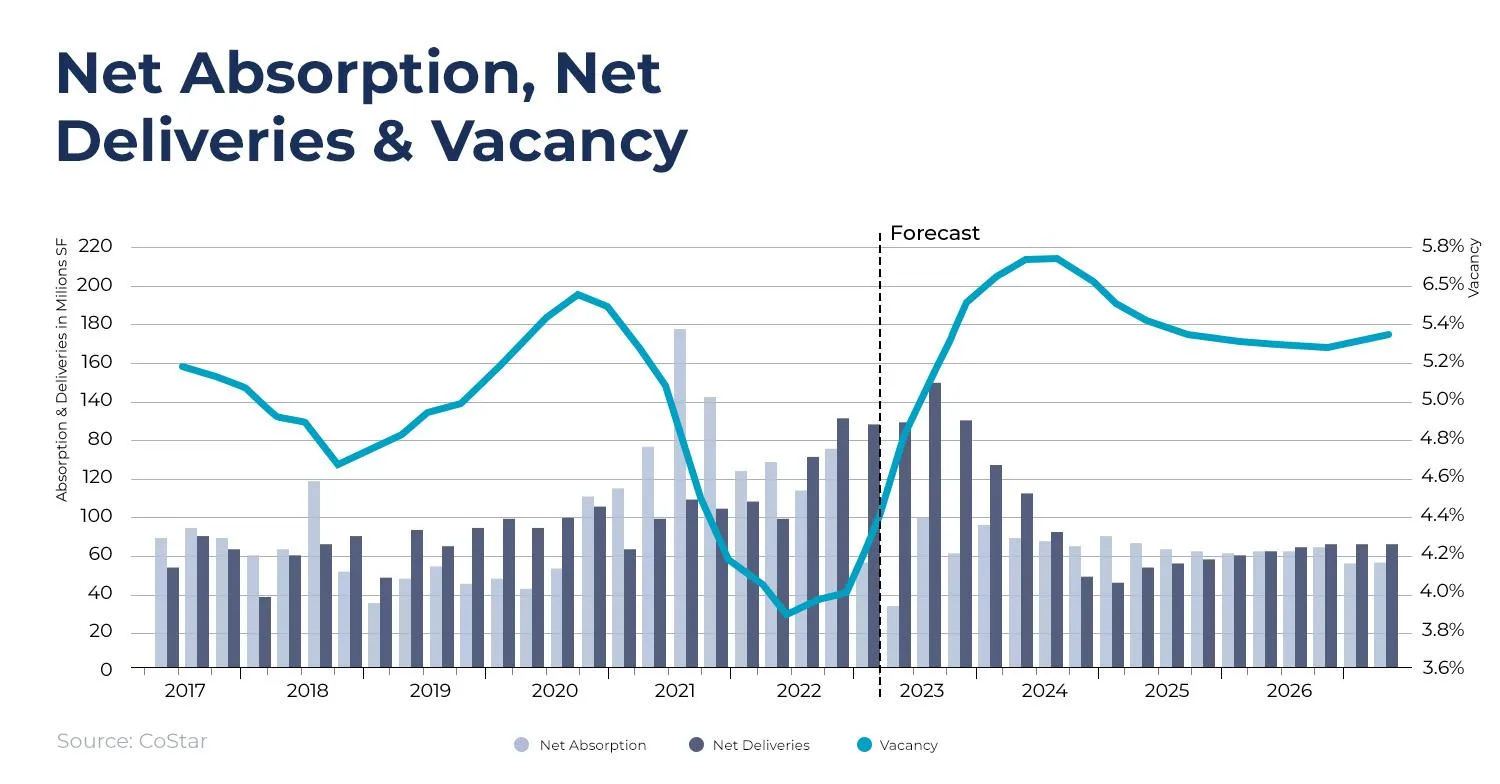
The Dallas-Fort Worth metroplex has become the preeminent industrial logistics hub in the United States. As of 2024, the market encompasses approximately 1 billion square feet of industrial space. Since 2020, over 200 million square feet of new industrial space has been delivered. The vacancy rate has stabilized near 10%, a figure that reflects robust new supply being absorbed by consistent demand. Notably, major global firms such as Sumitomo Corporation have entered the market, underscoring institutional confidence in the region's long-term trajectory.
Houston
The Houston metropolitan area possesses the largest industrial real estate inventory in the state. The market comprises approximately 700 million square feet of warehouse and distribution space. Net absorption has been strong, with annual figures consistently in the tens of millions of square feet. The vacancy rate as of 2024 was approximately 8.5%. Houston's strategic position as a global energy capital and its proximity to the Port of Houston and the Gulf Coast petrochemical complex create a unique demand profile that combines traditional logistics with energy-sector industrial needs.
San Antonio / Austin (I-35 Corridor)
The combined San Antonio-Austin corridor along Interstate 35 represents one of the fastest-growing industrial markets in the state. The San Antonio industrial market alone contains approximately 130 million square feet with a vacancy rate of approximately 8.3% as of 2024. The market has seen significant new construction, with millions of square feet delivered annually. The Austin market adds another dimension of tech-driven demand, with a total industrial inventory approaching 70 million square feet.
Critical to the Lumicre thesis, modern Class A facilities delivered within the last decade are capturing the bulk of net absorption. Occupiers are increasingly prioritizing automation-ready buildings with higher power capacities and infrastructure that supports long-term network efficiency.
Global Trade and the Nearshoring Super-Cycle
Texas is the vital artery for North American trade. Global supply chains are rapidly reconfiguring. Companies are moving production away from Asia. They are bringing manufacturing back to North America. This is called nearshoring. Texas is the primary beneficiary of this trend.
In 2023, Mexico surpassed China as America's top trade partner. This historic shift transforms continental commerce. In 2024, trade with Mexico reached $839.6 billion. Texas processes 67 percent of all US-Mexico imports. It processes 64 percent of all exports. This physical movement of goods requires vast industrial space.
Port Laredo
Port Laredo is the epicenter of this activity. It is the busiest inland port in the Western Hemisphere. In 2025, Port Laredo recorded $353.94 billion in international trade. This was a 4.4 percent increase from the previous year. Thousands of commercial trucks cross this border daily. They move automotive parts, technology components, and consumer goods. These goods flow directly up the I-35 corridor. They fill warehouses across the Texas Triangle.
Port of Houston
Simultaneously, the Port of Houston drives immense maritime trade. It is the largest port for waterborne tonnage in the nation. In 2025, Port Houston handled over 4.3 million twenty-foot equivalent units (TEUs). This set a record for container volumes. The port supports 1.54 million jobs in Texas. It generates billions in economic value. Goods arriving by sea must be stored. They must be sorted. They must be distributed. This creates relentless demand for high-quality industrial real estate.
The Disruptive Shift in Industrial Assets
We apply Clayton Christensen's theory of disruptive innovation here. The real estate market is changing fundamentally. Old warehouses are becoming obsolete. They lack the physical specifications for modern logistics. They have low roofs. They have small truck courts. Most importantly, they lack adequate power.
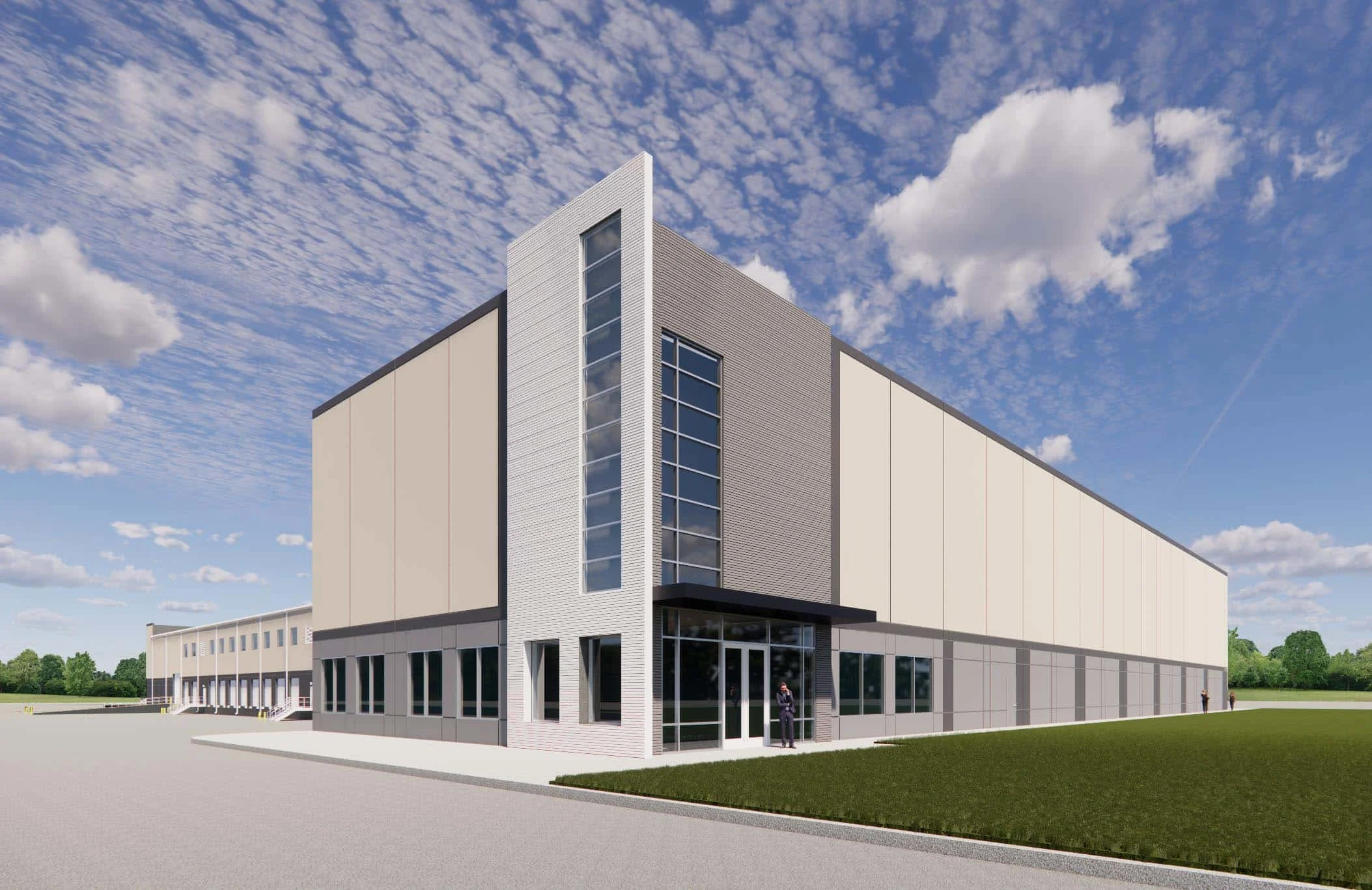
We build future-proofed warehouses. We utilize a blue ocean strategy. We do not compete for outdated, low-power buildings. We create uncontested market space. We build what the modern supply chain demands. Our properties target 40-foot clear heights. We build expansive truck courts. We include dual truck entries and efficient trailer circulation. These features are critical for national e-commerce users. They are essential for modern 3PL operators.
A standard warehouse is just a passive storage box. A future-proofed warehouse is an active logistical node. It is a high-utility asset. It is a critical piece of advanced supply chain infrastructure. This differentiation is our competitive moat. It allows us to command premium rents. It attracts high-credit institutional tenants. It maximizes the long-term enterprise value of our fund.
The Electricity Imperative: Battery-Powered Trucking
The most critical constraint for future logistics is electricity. The trucking industry is electrifying rapidly. Medium and heavy-duty vehicles require massive power to recharge. This creates a severe infrastructure bottleneck. We solve this bottleneck. We will build warehouses with up to 75,000 amps of power availability.
The industry is adopting the Megawatt Charging System (MCS). This is a new international standard for heavy-duty electric vehicles. MCS chargers can deliver up to 3.75 megawatts of power. They push current levels beyond 1,000 amps per charger. A Class 8 electric tractor requires a 1.6-megawatt charge to recover 400 miles in 30 minutes.
A logistics hub operating a fleet of electric trucks requires immense grid capacity. Ten MCS chargers operating simultaneously will draw tens of megawatts. A standard legacy warehouse cannot support this. It cannot even come close. By designing facilities with 75,000 amps of power, we anticipate this exact need. Our warehouses act as decentralized power nodes. They allow fleet operators to charge vehicles on-site. This eliminates downtime. It provides a massive operational advantage to our tenants.
Robotics, Automation, and Artificial Intelligence
Warehouses are becoming highly automated. Labor shortages and rising costs drive this shift. Companies must move goods faster and more accurately. They deploy Autonomous Mobile Robots (AMRs). They install Automated Guided Vehicles (AGVs). They build massive Automated Storage and Retrieval Systems (AS/RS).
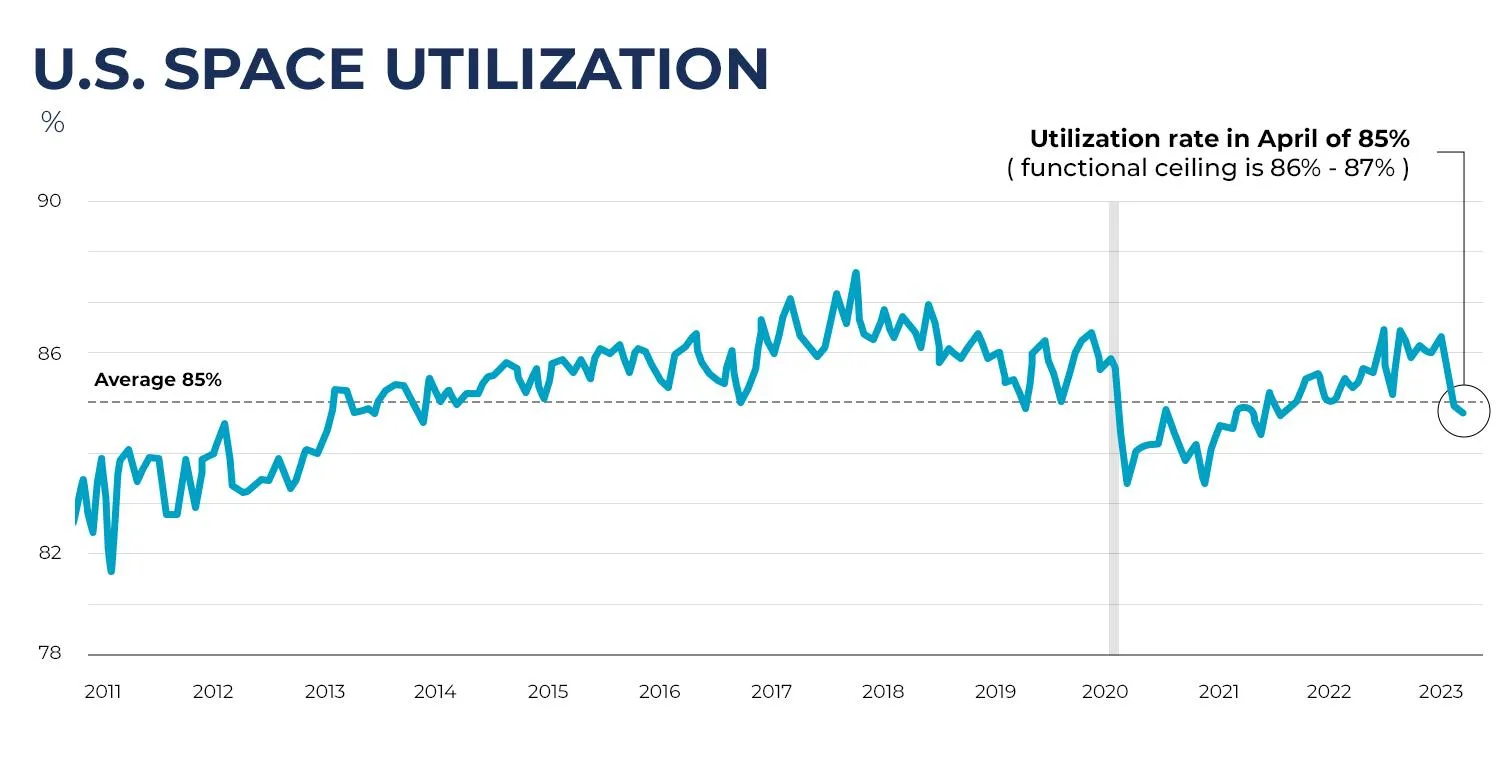
These advanced robotic systems require substantial electricity. Automation significantly increases the energy consumption per square foot in a facility. The integration of Artificial Intelligence makes this even more intensive. AI systems manage inventory. They optimize routing. They control the robots. This physical AI revolution is reshaping industrial real estate.
We must confront the brutal facts. The brutal fact is that the power grid is constrained. The Electric Reliability Council of Texas (ERCOT) faces surging demand. By 2030, demand will nearly double. This is driven by data centers, crypto mining, and industrial electrification. Securing heavy power today is a massive competitive advantage.
Our warehouses provide the electrical capacity required for total automation. They can support cold storage users. They can support advanced manufacturing. They can support heavy robotics. This flexibility reduces our risk. It broadens our tenant base. It makes our assets highly resilient against economic shocks.
Conclusion
Our thesis is proven by the data. The Texas economy will boom for the next 25 years. Global trade will continue to flow through the state. Supply chains will demand advanced, automated facilities. Electric trucking will require massive transmission access or perhaps even on-site power generation.
We buy and build future-proofed warehouses. We secure 10-100-acre parcels. We navigate the complex entitlement processes. We aim to deliver millions of square feet of future-proofed space. We aim to provide 75,000 amps of power. This strategy creates true value. It protects investor capital. It delivers superior risk-adjusted returns. It is the definitive blue ocean strategy for commercial real estate.
Works Cited
- SCOA Enters Industrial Real Estate Market with Dallas-area Projects | Sumitomo Corporation in North, Central and South America, accessed February 24, 2026, https://www.sumitomocorp.com/en/us/business/case/local/dallas_projects
- The Complete Guide to Class A Warehouse Construction in Dallas, accessed February 24, 2026, https://blog.eb3construction.com/construction/design-build-contracting/class-a-warehouse-construction-dallas/
- Port Laredo Reports $353.94 Billion in International Trade in 2025 — Protexas Industry, accessed February 24, 2026, https://www.protexasindustry.com/en/article/port-laredo-reports-353-94-billion-in-international-trade-in-2025
- Port Statistics — Port Houston, accessed February 24, 2026, https://porthouston.com/about/our-port/statistics/
- Port Houston Celebrates Best Year Yet Up 3% Total Tonnage, 4% TEUs, accessed February 24, 2026, https://porthouston.com/wp-content/uploads/2026/01/Port-Houston-Celebrates-Best-Year-Yet.pdf
- Texas' energy demand may exceed supply in 2026, but experts caution against panic, accessed February 24, 2026, https://www.texastribune.org/2025/02/13/texas-power-grid-ercot-energy-forecast/